
![A one-day tour of Dazu Rock Carvings in Chongqing [World Cultural Heritage Site + One of the World's Eight Great Grottoes]](https://image.kkday.com/v2/image/get/c_fill%2Ch_800%2Cq_55%2Ct_webp%2Cw_1240/s1.kkday.com/product_scm_15285/20260329092024_vDtsu/png)
![A one-day tour of Dazu Rock Carvings in Chongqing [World Cultural Heritage Site + One of the World's Eight Great Grottoes]](https://image.kkday.com/v2/image/get/c_fill%2Ch_400%2Cq_55%2Ct_webp%2Cw_500/s1.kkday.com/product_scm_15285/20260329092029_2VmEB/png)
![A one-day tour of Dazu Rock Carvings in Chongqing [World Cultural Heritage Site + One of the World's Eight Great Grottoes]](https://image.kkday.com/v2/image/get/c_fill%2Ch_400%2Cq_55%2Ct_webp%2Cw_500/s1.kkday.com/product_scm_15285/20260329092030_iDuf0/png)
![A one-day tour of Dazu Rock Carvings in Chongqing [World Cultural Heritage Site + One of the World's Eight Great Grottoes]](https://image.kkday.com/v2/image/get/c_fill%2Ch_400%2Cq_55%2Ct_webp%2Cw_500/s1.kkday.com/product_scm_15285/20260329092024_P616p/png)
![A one-day tour of Dazu Rock Carvings in Chongqing [World Cultural Heritage Site + One of the World's Eight Great Grottoes]](https://image.kkday.com/v2/image/get/c_fill%2Ch_400%2Cq_55%2Ct_webp%2Cw_500/s1.kkday.com/product_scm_15285/20260329092030_enLbk/png)
Package Options


Product Info
The content of this product is provided by machine translation and may not reflect the actual information, please take this into consideration before booking.
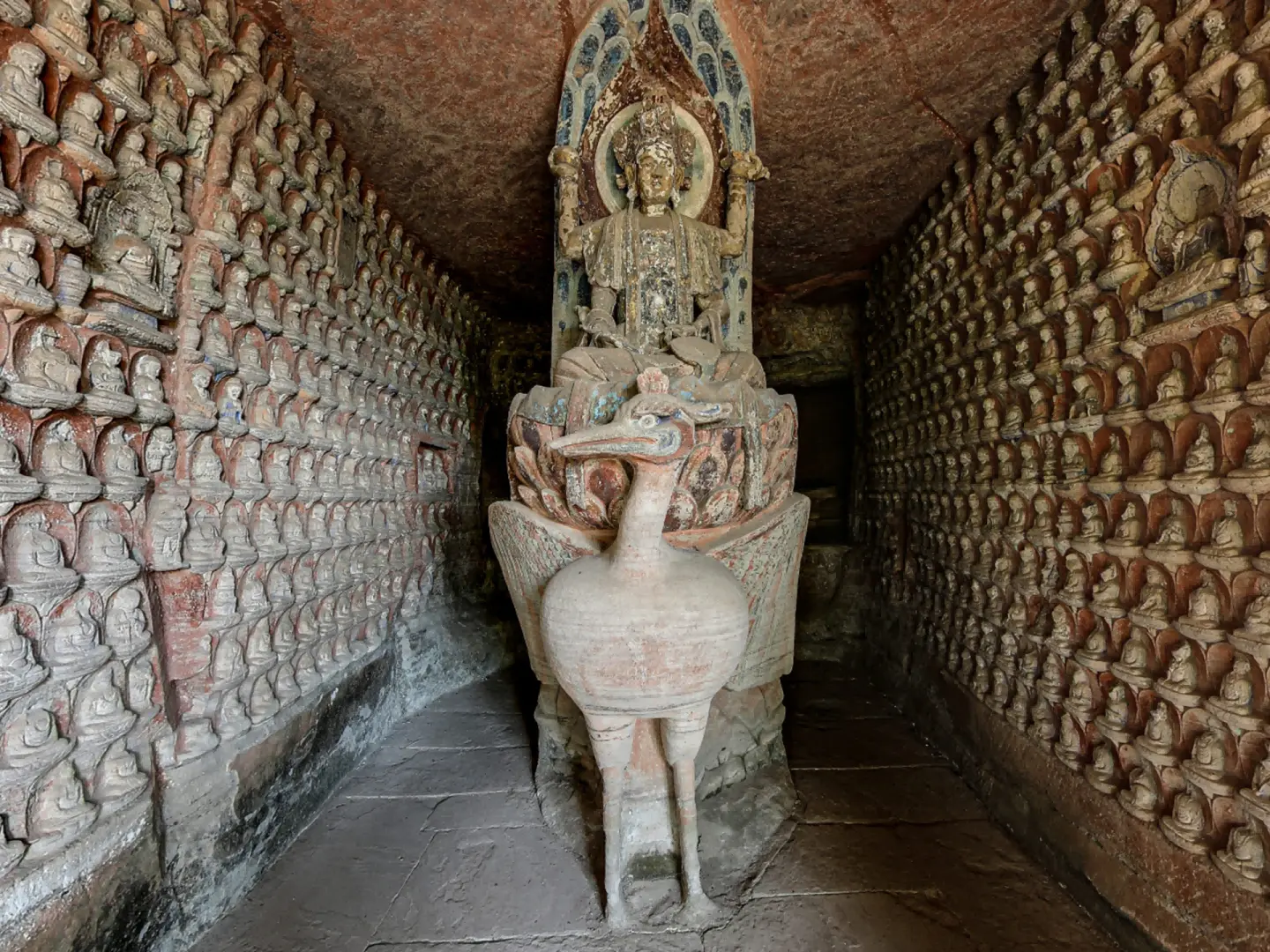
The Dazu Rock Carvings, located in Dazu District, Chongqing, are a collective term for 141 cliff carvings within the district. These include national-level sites such as Baodingshan, Beishan (including Duobao Pagoda), Nanshan, Shimenshan, Shizhuanshan, Miaogaoshan, and Shuchengyan; municipal-level sites such as Jianshanzi, Qianfoyan, Fengshan Temple, Shengshui Temple, Chenjiayan, and Pusheng Temple; and 61 district-level sites including Banchanggou. There are approximately 50,000 statues, primarily Buddhist in theme, followed by Taoism. The carvings are mainly high and low reliefs, with a few in the round and a very few incised lines. The Dazu Rock Carvings are considered on par with the Yungang Grottoes in Datong, Shanxi; the Longmen Grottoes in Luoyang, Henan; and the Mogao Grottoes in Dunhuang, Gansu.
The Dazu Rock Carvings were initially carved during the Yonghui period of the early Tang Dynasty, continued through the late Tang and Five Dynasties, flourished in the Song Dynasty, and were further expanded during the Ming and Qing Dynasties. Ultimately, they formed a vast group of rock carvings, representing the pinnacle of Chinese stone carving art and considered a representative of late-period Chinese grotto art. The Dazu Rock Carvings are renowned worldwide for their grand scale, exquisite carvings, diverse themes, rich connotations, and excellent preservation. They are unique in their integration of Buddhism, Taoism, and Confucianism, making them a rare find. Their distinct national, secular, and everyday characteristics set them apart in Chinese grotto art. Through a wealth of artifacts and historical texts, they showcase the stylistic development and changes in Chinese grotto art from the late Tang to the Song Dynasty, as well as significant advancements in folk religious beliefs. They have made important contributions to the innovation and development of Chinese grotto art, possessing irreplaceable historical, artistic, and scientific value compared to earlier grottoes.
In December 1999, the Dazu Rock Carvings were inscribed on the UNESCO World Heritage List, making it the only World Cultural Heritage site in Chongqing.
Baodingshan, located in Baoding Town, Dazu District, Chongqing, has an altitude of 527.83 meters and is open from 08:30 to 16:30. It is a Buddhist esoteric cave temple site, carved under the supervision of the Southern Song Dynasty monk Zhao Zhifeng over a period of more than 70 years, from 1174 to 1252. The stone carvings are centered on Dafowan (Great Buddha Bay) and include 13 scenic spots such as Xiaofowan (Small Buddha Bay) and Guangda Mountain, with nearly 10,000 statues remaining. The cliff face of Dafowan is 500 meters long and contains 31 niches with statues of the Three Sages of Huayan, Thousand-Hand Guanyin, and the Nirvana of Shakyamuni, covering themes of Buddhist stories and secular life. The niches are laid out in a coherent manner and inscribed with steles depicting the deeds of Liu Benzun (Liu Benzun). It integrates Buddhist, Confucian, and Taoist thought, forming a model of nationalized and life-oriented cave art, and is known as "Paying homage to Emei in the morning and to Baoding in the afternoon."


The stone carvings are located on Beishan (Longgang Mountain), 2 kilometers north of Dazu District, Chongqing. Carving began in the first year of the Jingfu era of the Tang Dynasty (892 AD) and continued until the Shaoxing era of the Southern Song Dynasty, spanning over 250 years. The carvings are centered around Dafowan and are distributed across five sites: Guanyinpo, Yingpanpo, Foeryan, and Beita Temple. The carvings extend over 500 meters along the cliff face, reaching a height of approximately 7 meters. Currently, there are 290 niches and caves containing over 5,000 statues, arranged in a crescent shape. The themes encompass Esoteric Buddhism and the Three Stages School of Buddhism.

The Dazu Rock Carvings Museum, a national first-class museum, is located at No. 7 Beishan Road, Longgang Street, Dazu District, Chongqing. Covering an area of 58.5 hectares and with a building area of 18,000 square meters, it is a specialized museum of rock carving art. Its main exhibits are the outdoor grotto temple remains represented by the "Five Mountains" grottoes: Beishan, Baodingshan, Nanshan, Shimenshan, and Shizhuanshan. The museum's permanent exhibition is "Artistic Rebirth—Dazu Rock Carvings Exhibition," and it features the world's largest 360-degree panoramic theater and an academic lecture hall. As of 2022, the museum's collection included 820 pieces/sets of cultural relics, of which 81 pieces/sets were precious artifacts.


FAQ
The Dazu Rock Carvings, located near Chongqing, are a series of exceptional religious sculptures and carvings created between the 9th and 13th centuries. They represent a significant development in Chinese grotto art, blending Buddhist, Taoist, and Confucian influences. Their historical significance lies in showcasing the harmonious integration of different religious beliefs and the evolution of rock carving art during a pivotal period in Chinese history.
A comprehensive day tour of the Dazu Rock Carvings typically includes visits to two main sites: Baodingshan (Mount Baoding) and Beishan (North Mountain) Rock Carvings. Baodingshan is known for its grand scale and narrative style, while Beishan features earlier, more delicate carvings. Some tours may also include a visit to the Dazu Stone Carving Art Museum to provide further historical and artistic context.
At Baodingshan, the artistic characteristics are marked by their massive scale, intricate details, and a strong narrative quality, often depicting Buddhist sutras and scenes from daily life. Prominent themes include the ten stages of hell, the wheel of life, and various deities, all integrated into the natural landscape to create a profound spiritual experience. The carvings are renowned for their realistic portrayal and emotional depth.
The Beishan Rock Carvings offer a glimpse into an earlier period of Dazu's artistic development, primarily dating from the late Tang Dynasty to the Southern Song Dynasty. Visitors can expect to see more refined and delicate Buddhist carvings, particularly exquisite statues of Guanyin (Bodhisattva of Compassion) and other celestial beings. The site features smaller, more intimate grottoes compared to Baodingshan, showcasing a different style of artistry.
The Dazu Rock Carvings are approximately a two-hour drive from Chongqing city. The most convenient way to travel is often via a pre-arranged day tour which includes round-trip transportation by private car or tourist bus. Alternatively, public buses are available from Chongqing's main bus stations to Dazu County, from where local taxis or smaller buses can take you to the individual carving sites.
For a comprehensive and immersive experience, a full day is highly recommended to explore the Dazu Rock Carvings. This allows ample time to visit both the Baodingshan and Beishan sites, appreciate the intricate details of the carvings, and gain a deeper understanding of their historical and cultural significance without feeling rushed. Typically, about 3-4 hours are spent at Baodingshan and 1-2 hours at Beishan.
When booking a Dazu Rock Carvings day tour, for example through KKday, the price typically includes convenient round-trip transportation from a designated meeting point in Chongqing, entry tickets to both the Baodingshan and Beishan Rock Carvings, and often the services of a knowledgeable professional guide. This comprehensive package ensures a hassle-free and enriching cultural exploration, handling all major logistics for visitors.
The Dazu Rock Carvings were inscribed as a UNESCO World Cultural Heritage site due to their outstanding universal value as a unique and extensive series of religious sculptures. They showcase a remarkable artistic achievement, providing an insight into the harmonious synthesis of Buddhism, Taoism, and Confucianism, and representing the pinnacle of Chinese grotto art from the 9th to 13th centuries, demonstrating an exceptional evolution of artistic form.
Get Help


