


LEHK Fencing Club | Fencing Introductory Courses | 4-Lesson Intensive Course for Adults | One-on-One Personalized Introductory Courses | Summer Fencing Certificate Courses | KKday Exclusive Offers
Course Introduction
1) Group courses
Gradually starting with warm-up exercises, the students will gradually begin fencing training. Group training helps students learn from each other and practice together before actual combat, which helps improve their combat experience.
2) One-on-one lessons
One-on-one lessons are the fastest and most effective way to learn fencing. The lessons are student-centered, and the instructor will focus on improving the student's weaknesses. Furthermore, one-on-one lessons are highly personalized, allowing students to choose the number of hours and times per week.
Package Options
Physical Activities
| Sport type | Fencing |
| Class mode | Private class, Group class |
| Activity level | Beginner |
Product Info
- Package Details -
1. Fun Fencing Trial Class (1 hour)
Target Audience: Absolute beginners
A minimum of 4 participants is required for each trial class.
Trial Class Schedule:
BB Kindergarten Plastic Foil Class (Ages 4-6)*
6/9 1745-1845
2/9 1800-1900
3/10 1930-2030
Primary School Foil Class (Ages 7-10)*
5/9 1000-1100
10/10 1930-2030
17/10 1930-2030
*Each person is limited to one registration. If you sign up for a regular fencing course at the center on the same day after completing the trial class, you will receive an instant rebate of $80-$100 (depending on the amount paid when booking via KKday).
Adult Metal Foil Class (Ages 18+)*
8, 22/9 2000-2130
6, 20/10 2000-2130
*Each person is limited to one registration. If you sign up for a regular fencing course at the center on the same day after completing the trial class, you will receive an instant rebate of $100-$250 (depending on the amount paid when booking via KKday).
2. Adult 4-Session Fast-Track Course | Includes free glove, foil, body wire, and chest protector (Total value $880)
Target Audience: Adult beginners (Ages 18 or above)
Class size: 6 participants
Schedule: 3, 10, 17, 24/9; 8, 15, 22, 29/10 Every Thursday 2000-2130
Includes free glove, foil, body wire, and chest protector (Total value $880). No leave requests or make-up classes are permitted.
Course highlights include:
Fencing footwork: Distance defense & forward/backward jumps and lunges
Sword handling: Familiarization with attacks & parry-ripostes, counter-attacks, and continuous attacks
High-intensity drills: Similar/dissimilar connections & reading the opponent
3. One-on-One Exclusive Experience Course
Target Audience: Open to all ages
Price: HK$800/person, 19% Off for two people: HK$1300/two people
Schedule: 7, 14, 21, 28/9; 5, 12, 19, 26/10 Every Monday 2000-2100
Price includes equipment rental

Founded by a group of former Hong Kong team coaches and team members, the Fencing House offers group and private lessons in foil, epee or saber. Instructors will teach technical adjustments, footwork, sword timing, hand movements, etc., suitable for students of all ages and levels.

Professional fencing coaches carefully plan fencing experience courses suitable for different age groups (infants/primary school/teens/adults), providing equipment for students to quickly learn about fencing, the Olympic gold medal sport.

Mr. Zhang Xiaolun, Technical Director of the Fence House and senior member of the foil team, has been engaged in full-time fencing for 15 years. He is a member of the 2020 Hong Kong foil team at the Tokyo Olympics. He led the men's foil team to the top 8 of the Olympics and achieved unprecedented outstanding results.

Sign up for the adult 4-session quick course and receive gloves, sword, hand line, and chest guard (total value $880)

Inclement Weather Arrangements

Summer Sword-Making Class - Schedule
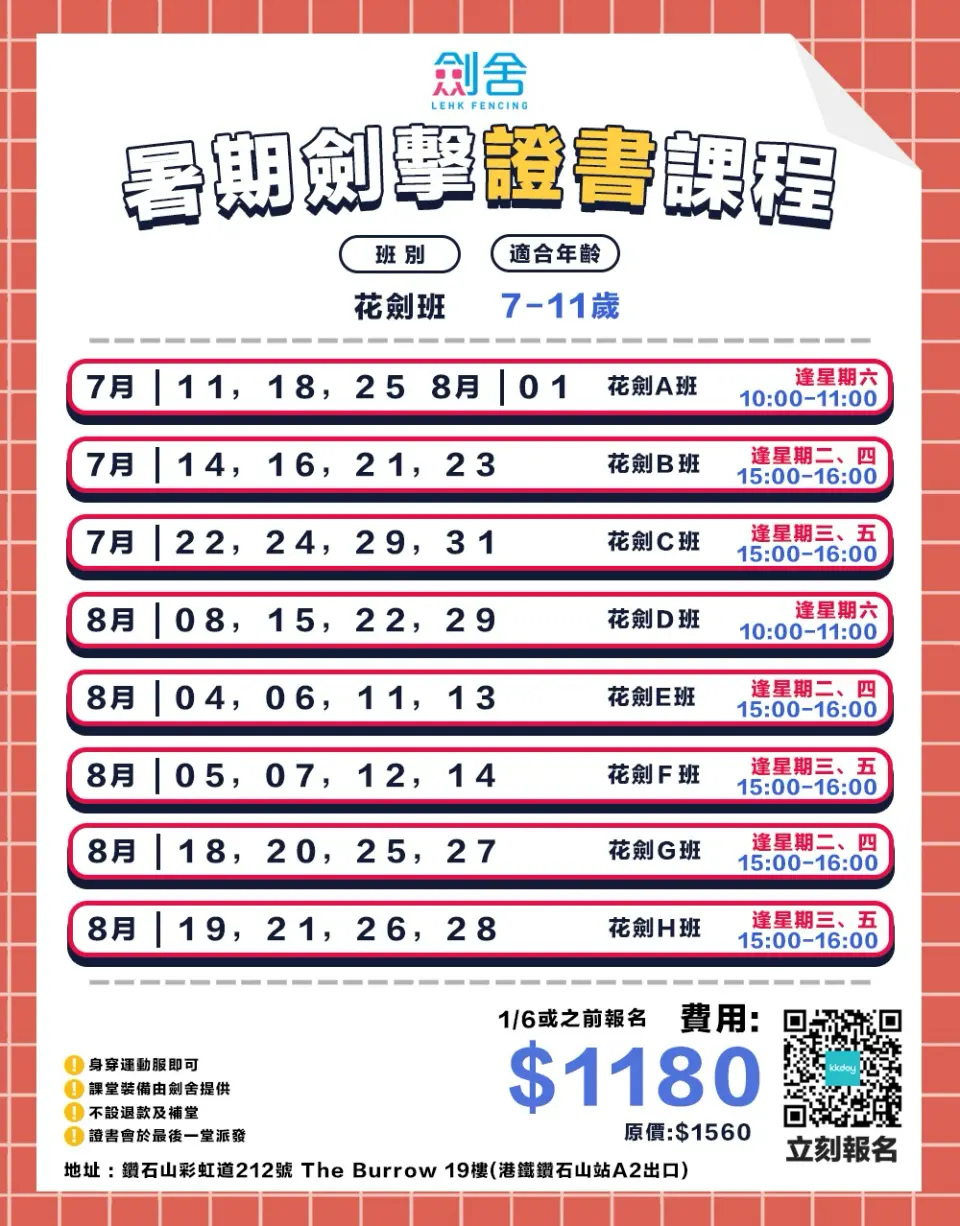
Summer Foil Fencing Class - Schedule
Important Info
Includes/Excludes
- Fencing experience course
- Other expenses not mentioned above
Reminders
Participants are advised to wear sports tops, sports pants and sneakers
If the group cannot be formed, the company will notify you three working days before departure to arrange another departure date.
How to Redeem Your Voucher
How to Use Your Voucher
- Please present your QR code on-site
Voucher Redemption Period
- The voucher must be redeemed on the selected date and within operating hours; Invalid after expiration
Experience Location
Location Name: Sword House
Address: Room 1902, 19/F, The Burrow, 212 Choi Hung Road, Diamond Hill
Cancellation Policy
- Once the order has been completed, it cannot be canceled, modified, or refunded
- Due to time zone differences, the confirmed cancellation date is based on the supplier’s local time. Please allow 2–5 business days to process your cancellation request, after which the cancellation fee will be charged according to the product’s cancellation policy. Once your refund request is confirmed, KKday will initiate the refund to your original payment method within 15 days. The actual refund timing depends on your card-issuing bank’s policy.
FAQ
1. What is the ideal age to start a fencing trial course?
Fencing is a sport suitable for a wide range of ages, including adults. While many begin in childhood, a trial course is specifically designed to introduce the foundational aspects and techniques to participants regardless of their prior experience. It's an excellent opportunity for adults to discover the sport and assess their interest and aptitude without any age-related barriers.
2. Can adults of any age participate in fencing lessons?
Yes, adults of varying ages are fully capable of participating in and excelling at fencing lessons. The courses are structured to accommodate different skill levels, focusing on progressive learning from basic footwork to advanced techniques. Fencing offers benefits for mental agility and physical fitness for all ages, making it a rewarding activity for any adult seeking a new challenge.
3. What personal development benefits can individuals gain from a fencing trial course?
Participating in a fencing trial course offers numerous personal development benefits. It significantly enhances strategic thinking, problem-solving abilities, and concentration due to the sport's tactical nature. Fencing also improves physical attributes like agility, coordination, and reflexes. Moreover, it fosters discipline, self-control, and confidence, contributing to holistic personal growth.
4. What can participants expect to learn during a fencing trial course?
During a fencing trial course, participants will learn the fundamental techniques of the sport from experienced instructors. This includes mastering essential footwork patterns, precise hand movements, and the timing required for effective fencing strikes. The course incorporates warm-up exercises, foundational drills, and opportunities for practical application to help students quickly grasp the basics before engaging in simulated combat.
5. What are the main disciplines of the sport of fencing?
The sport of fencing is primarily categorized into three main disciplines, each utilizing a distinct weapon and having specific target areas: Foil, Épée, and Sabre. Foil is a light thrusting weapon where only the torso is a valid target. Épée is a heavier thrusting weapon where the entire body can be targeted. Sabre is a light cutting and thrusting weapon, with the target area being any part of the body above the waist, excluding the hands and the back of the head.
6. What is the typical investment for starting fencing lessons?
The investment for starting fencing lessons typically covers comprehensive instruction from former team coaches, access to a dedicated training facility, and the provision of all necessary fencing equipment for the duration of the course. This setup allows new participants to delve into the sport and develop skills without the immediate outlay for personal gear. Different course formats, such as group versus one-on-one lessons, may influence the overall structured investment.
7. Are group and one-on-one fencing lessons available, and how do they differ?
Yes, both group and one-on-one fencing lessons are available to cater to different learning preferences. Group courses provide a dynamic environment where students learn collaboratively, practice together, and build combat experience through peer interaction. One-on-one lessons offer highly personalized coaching, allowing instructors to focus on individual student weaknesses and strengths, offering tailored improvements and flexible scheduling for faster progress.
8. Is fencing equipment provided for participants in a trial course?
Yes, all essential fencing equipment is provided for participants enrolled in a trial course. This includes the specialized weapon, a protective mask, a fencing jacket, and gloves. The provision of equipment ensures that new participants can experience the sport safely and comfortably from the outset, allowing them to focus entirely on learning and enjoying the activity without the initial need to purchase gear.


