
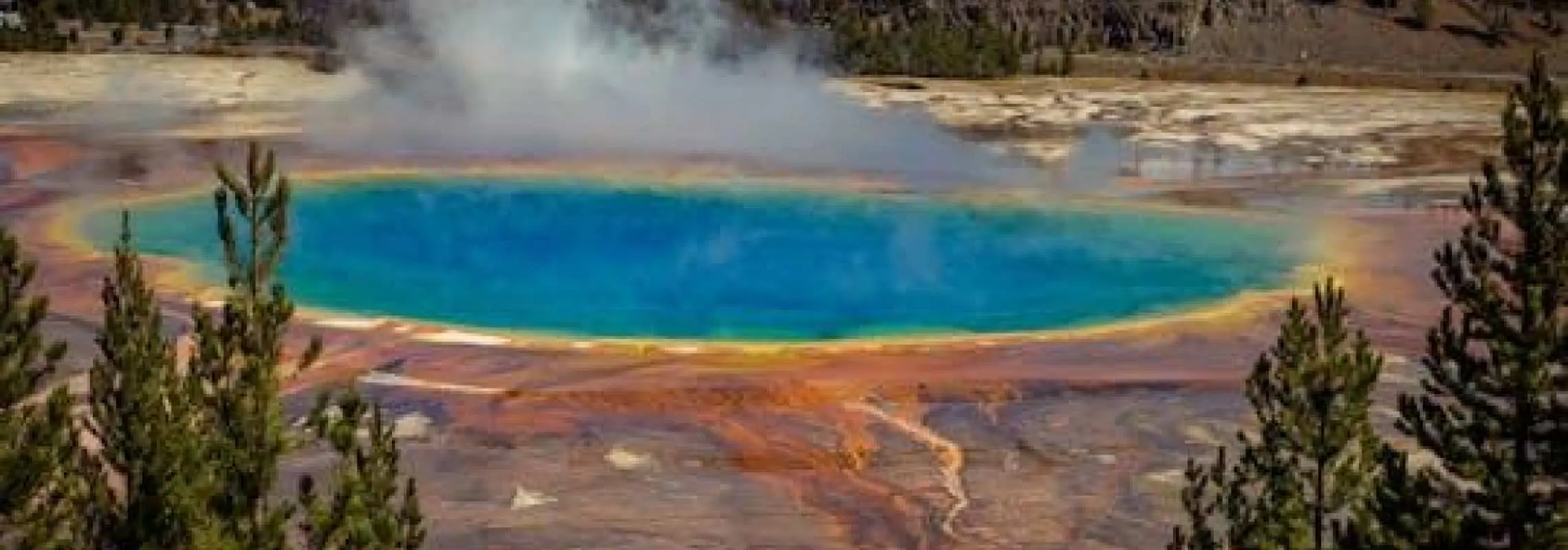
Audio-guided driving tour of Yellowstone and Grand Teton
- Visit Yellowstone, the first America's National Park and Grand Teton National Park, drive through beautiful sceneries listening to interesting stories.
Package Options


Product Info
Important Info
Reminders
Please refer to your voucher for final information regarding meeting points, pick-up locations, and pick-up time
Meeting point description: It's suggested starting your tour from one of the Yellowstone or Grand Teton National Park entrances. But you can also join the tour anywhere along the route and pick up commentary at the next point.
Extra fees to be paid on-site:Yellowstone National Park entrance fees (private vehicle $35.00, motorcycle $30.00, pedestrian $20.00)
Grand Teton National Park entrance fees (private vehicle $35.00, motorcycle $30.00, pedestrian $20.00)
Know in advance:This is an audio-guided self-driving tour; there will be no physical person guiding you, nor transportation
You'll receive a confirmation email with all the instructions to install the GuideAlong (GyPSy Guide) App and download the tour. It's suggested to download it before your arrival in the location
The tour requires a supported mobile device for navigation: an iPhone running iOS 15 or later, an Android device running Android 9 or later, or an iPad/tablet with GPS and cellular service
It's suggested to spend at least 2 days in Yellowstone and 1 day in Grand Teton in order to be able to see the main features of each Park
The Grand Loop it's around 250, drive between the Parks on the John D Rockefeller Jr Memorial Parkway, and explore Grand Tetons roads. The complete tour route is approximately 120 miles each way, including highways 12, 89 and 9
FAQ
1. Can visitors realistically explore both Yellowstone and Grand Teton National Parks in a single day with a driving tour?
While it's technically possible to drive through both Yellowstone and Grand Teton National Parks in one day, it is highly recommended to allocate at least 3 to 5 days for a comprehensive and enjoyable driving tour. Attempting to visit both in a single day would only allow for a superficial overview, with very limited time to stop, explore, or fully appreciate the diverse natural wonders and wildlife of each park.
2. What are the entry requirements and costs for visiting Yellowstone and Grand Teton National Parks?
Entry to Yellowstone and Grand Teton National Parks requires a valid park pass. A single pass covers both parks for seven consecutive days. This pass is typically per vehicle and can be purchased at any park entrance station or online in advance. The audio-guided driving tour itself does not include the park entry fee, which is a separate cost for all visitors entering the national parks.
3. What are the best ways to navigate within Yellowstone National Park for a self-guided driving tour?
For a self-guided driving tour within Yellowstone National Park, the primary method of navigation is by vehicle on the park's well-maintained roads. Visitors should use a current park map, available at entrance stations and visitor centers, to plan routes. The park is organized around the 'Grand Loop Road,' which connects major attractions. Always follow speed limits and look out for wildlife.
4. How can visitors navigate Yellowstone National Park effectively without reliable cell service?
Reliable cell service is limited or nonexistent in many areas of Yellowstone National Park. To navigate effectively, download offline maps (e.g., Google Maps) for the park area before your trip. Carry a physical park map, which is crucial for identifying roads, attractions, and services. The audio-guided tour, which provides stories and directions, is designed to work offline, enhancing navigation without needing cell reception.
5. Which states encompass the majority of Yellowstone National Park's area?
Yellowstone National Park is primarily located in Wyoming, which contains about 96% of its land area. Smaller sections of the park extend into two other states: approximately 3% lies within Montana, and a tiny portion (about 1%) is situated in Idaho. Its unique geographic location across three states adds to its expansive and diverse landscape.
6. What are the specific regulations regarding pets, such as dogs, at attractions like Old Faithful in Yellowstone National Park?
Pets are generally restricted in Yellowstone National Park to protect wildlife and natural resources. Dogs must be on a leash no longer than six feet and are permitted only in developed areas such as roads, parking lots, and campgrounds. They are strictly prohibited on boardwalks, trails, in thermal areas, or in the backcountry. Therefore, dogs cannot accompany owners to view Old Faithful from the boardwalks or trails around the geyser basin.
7. How can an audio-guided tour enhance the experience of visiting Yellowstone and Grand Teton National Parks?
An audio-guided tour significantly enhances the experience by providing engaging stories, historical facts, and ecological insights as you drive through Yellowstone and Grand Teton National Parks. It acts as a personal guide, highlighting points of interest, explaining geological features, and offering tips for spotting wildlife. This allows visitors to fully immerse themselves in the stunning scenery and rich history without needing to consult guidebooks while driving.
8. What are the primary access points and driving considerations for entering Yellowstone National Park?
Yellowstone National Park has five main entrances: North (Gardiner, MT), West (West Yellowstone, MT), South (Jackson, WY via Grand Teton NP), East (Cody, WY), and Northeast (Cooke City, MT). Driving is the primary mode of access and exploration. Visitors must consider seasonal road closures, especially in winter, and check the park's official website for current road conditions. Plan routes carefully, as traffic can be heavy, and allow ample time for travel between attractions.


