

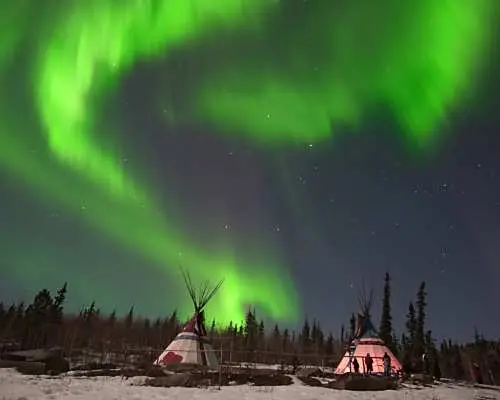


4-Day Whitehorse: Best Value Aurora Viewing / Basic / Canada
- Discover the rich history of Yukon's capital
- Professional photo service on each tour
- Enjoy three consecutive evenings at the exclusive AuroraCentre
- Comfortable transfers with our tour buses
Package options
Product Info
What You Can Expect
Know before you book
Reminders
A minimum of 1 traveler(s) are required for the tour to depart. If the number of participants does not reach the minimum requirement, the tour will be canceled. An email regarding tour cancellation will be sent 7 day(s) before the departure date
In case of delays caused by traffic, weather, or other force majeure factors resulting in the cancellation of some itinerary attractions, please contact customer service. We will arrange a partial refund for you
Please arrive at the designated location 10 minute(s) before the scheduled departure time, as the tour will depart on time
How to Redeem Your Voucher
How to Use Your Voucher
- Please present the e-voucher on-site
Pickup Point
Location Name: Whitehorse International Airport YXY
Address: Whitehorse International Airport YXYExperience Location
Location Name: Whitehorse International Airport YXY
Address: 75 Barkley-Grow CresMonday 04:00–21:00
Tuesday 04:00–21:00
Wednesday 04:00–21:00
Thursday 04:00–21:00
Friday 04:00–21:00
Saturday 04:00–21:00
Sunday 04:00–21:00
Please send us your flight arrival and departure details at time of booking so we can arrange the airport transfer.
FAQs
1. What scientific phenomenon causes the Aurora Borealis in regions like Whitehorse?
The Aurora Borealis, or Northern Lights, is caused by electrically charged particles from the sun colliding with gases in Earth's atmosphere. These collisions emit light, creating the vibrant dancing displays. Whitehorse's high latitude positions it directly beneath the auroral oval, making it an excellent location to witness this natural light show when conditions are right.
2. Is Whitehorse, Yukon, a suitable location for viewing the Northern Lights?
Yes, Whitehorse in Yukon, Canada, is highly suitable for Northern Lights viewing. Its northern latitude places it within the auroral oval, a band where auroras are most frequently seen. The city also benefits from low light pollution just outside its core and clear winter skies, creating ideal conditions for observing the spectacular celestial phenomenon.
3. Where can visitors experience optimal Northern Lights viewing during a Whitehorse tour?
For optimal Northern Lights viewing on a Whitehorse tour, visitors typically travel just outside the city center to dedicated viewing locations like the AuroraCentre. These spots are chosen specifically for their minimal light pollution, offering unobstructed views of the night sky. Such centers often provide comfortable facilities to enhance the viewing experience.
4. What is the best time of year to see the Northern Lights in Whitehorse, Yukon?
The best time of year to see the Northern Lights in Whitehorse, Yukon, is generally from late August to April. During these months, the nights are long and dark, which are crucial conditions for visibility. Peak activity often occurs during the equinoxes in September and March, but consistent viewing opportunities exist throughout this entire period, weather permitting.
5. How are visitors transported to aurora viewing sites from Whitehorse city center?
Visitors are typically transported to aurora viewing sites, such as the AuroraCentre, from the Whitehorse city center using comfortable tour buses. These transfers are designed to be convenient, ensuring a relaxed journey to locations far enough from city lights to provide clear, unobstructed views of the Northern Lights.
6. Beyond aurora viewing, what other experiences can travelers enjoy in Whitehorse, Yukon?
Beyond Northern Lights viewing, travelers in Whitehorse, Yukon, can explore the capital's rich history, visit local shops, and enjoy various winter sightseeing activities. Daytime is often free for optional excursions, such as dog sledding, ice fishing, snowshoeing, or exploring the city's museums and historical landmarks like the S.S. Klondike National Historic Site.
7. What facilities and comforts are provided at the AuroraCentre for Northern Lights viewing?
At the AuroraCentre, designed for Northern Lights viewing, visitors can enjoy comfortable facilities that enhance the experience. These often include warm shelters with cozy wood stoves or roaring campfires, providing a comfortable space to relax while waiting for the aurora to appear. Refreshments may also be available, ensuring a pleasant evening.
8. Is professional photography service included during the Northern Lights viewing experience?
Yes, professional photo service is typically included during the Northern Lights viewing experience. Expert photographers are on hand to capture high-quality images of both the aurora and visitors, ensuring memorable keepsakes of the spectacular phenomenon. This allows guests to fully immerse themselves without worrying about technical camera settings.


