



Package Options


Product Info
Purchase Notice
Reminders
Please refer to your voucher for final information regarding meeting points, pick-up locations, and pick-up time
Meeting point description: Please meet at the Córdoba Cathedral (olive tree next to the central fountain in Patio de los Naranjos) and please arrive 5 minutes before the departure time.(Mezquita-catedral de Córdoba, 14003 Córdoba, Spain)
This is a walking tour conducted by a local qualified guide of the Cathedral-Mosque of Córdoba. The meeting point is in Patio de Los Naranjos but you will visit all the monument inside
Visitors are required to wear face masks and to keep their distance from each other
The Premium option includes a smaller-group visit and a gift of Córdoba
FAQ
1. What is the historical significance of the Cathedral-Mosque of Córdoba?
The Cathedral-Mosque of Córdoba holds immense historical significance as a symbol of the complex cultural and religious history of Spain. Originally built as a mosque during the Islamic rule of Al-Andalus, it was a major center of learning and art. Its unique architecture reflects centuries of changing civilizations, serving as a testament to the coexistence and subsequent transformation of different faiths and empires in the region.
2. When was the Cathedral-Mosque of Córdoba originally constructed, and what was its initial purpose?
The construction of the Great Mosque of Córdoba began in 785 CE by Abd al-Rahman I, on the site of a Visigothic church. Its initial purpose was to serve as the principal congregational mosque for the city of Córdoba, which was then the capital of the Islamic Caliphate of Córdoba. It underwent several expansions over the centuries, growing to become one of the largest mosques in the world, symbolizing the power and intellectual prowess of Islamic Spain.
3. What architectural elements demonstrate the cultural fusion within the Cathedral-Mosque of Córdoba?
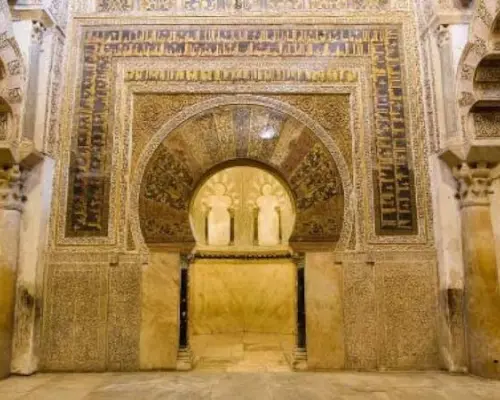
The Cathedral-Mosque of Córdoba uniquely fuses Islamic and Christian architectural styles. Key elements include the distinct red and white striped arches, a hallmark of its Islamic origins, and the ornate Mihrab, demonstrating intricate Islamic artistry. After the Reconquista, a Renaissance-style cathedral nave was built directly within the mosque's structure, introducing elements like Gothic vaults and Baroque altarpieces, creating a stunning juxtaposition of diverse artistic traditions.
4. How does the Cathedral-Mosque of Córdoba showcase both Islamic and Christian artistic styles?
The Cathedral-Mosque of Córdoba showcases Islamic styles through its vast hypostyle hall with hundreds of double-tiered columns and arches, the detailed calligraphy, and geometric patterns in areas like the Mihrab. Christian artistic styles are evident in the central cathedral, added later, featuring Gothic, Renaissance, and Baroque elements such as chapels, altarpieces, choir stalls, and stained glass windows. This blend offers a living museum of architectural evolution across different eras.
5. Are there specific areas within the Cathedral-Mosque of Córdoba that highlight its unique blend of styles?
Yes, the unique blend of styles is most evident in several key areas. The central nave of the cathedral, built directly into the heart of the former mosque, starkly contrasts the surrounding Islamic architecture. The Capilla Mayor and the Royal Chapel showcase Christian decorative arts. Additionally, the Patio de los Naranjos (Courtyard of the Orange Trees) retains its original Islamic design, offering a glimpse into the mosque's original outdoor space before entering the fused interior.
6. How did the Cathedral-Mosque of Córdoba transform after the Christian Reconquista?
After Córdoba was reconquered by Ferdinand III in 1236 CE, the Great Mosque was consecrated as a Roman Catholic cathedral. While much of the original mosque structure was preserved, significant transformations occurred. The most notable change was the construction of a large Renaissance cathedral nave, choir, and transept right in the center of the mosque in the 16th century. Various chapels were also added, altering its function and appearance to serve Christian worship.
7. What major structural changes occurred when the Great Mosque of Córdoba was converted into a cathedral?
The most significant structural change during the conversion was the construction of a large, cruciform Renaissance cathedral within the mosque's hypostyle hall. This involved removing many rows of original Islamic columns and arches to create space for the soaring cathedral nave, choir, and transept. Additionally, many smaller chapels were integrated along the perimeter, and altars were erected, fundamentally changing the internal layout and flow from a horizontal mosque plan to a vertical cathedral design.
8. What is the current primary function of the Cathedral-Mosque of Córdoba for visitors?
The Cathedral-Mosque of Córdoba primarily functions as an active Roman Catholic cathedral, where religious services are regularly held. However, it also serves as a major historical monument and cultural attraction, drawing millions of visitors annually. It offers a unique opportunity for visitors to explore its extraordinary architectural history, witnessing the harmonious, yet distinct, blend of Islamic and Christian art and design. It is designated as a UNESCO World Heritage site.


