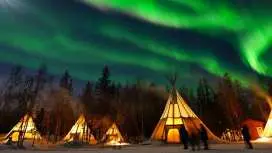
Airport pickup included a down jacket, snow pants, snow boots, and gloves. Bring your own warm clothing for Taipei winters (UNIQLO is acceptable), and they'll provide the rest. My husband and I both wore Columbia snow boots, but mine weren't slip-resistant and we kept slipping. Looking at the soles, my husband's boots had more teeth than mine, but thankfully they provided a complete set. Even the most expensive Taiwanese trendy brands aren't as warm as local clothing. The tour guides were all very nice, including people from Hong Kong and Taiwan, speaking Mandarin, English, and Cantonese. We watched the aurora from warm wooden cabins, transparent tents with heaters, and campfires. The guides would stay on the aurora and then call us out to see it. The campsite had hot water, hot cocoa, biscuits, tea, and coffee; you could even roast marshmallows. There were clean toilets and instant noodles for a fee. I've been on other tours, and while the directors were also nice, the vehicles were very cold (the snow on the ground didn't melt). Every guide was a great photographer; you can download photos online. If it's cloudy or foggy, we'll take a bus to chase the aurora borealis. On our last night, we changed locations three times. Although the aurora wasn't strong that night, there was a meteor shower. You can refer to the weather forecast to prepare mentally for chasing the aurora. You'll need to dress warmly; I recommend bringing a mask, a beanie, thermal clothing, hand warmers, and hot water—enough to cope with temperatures as low as -30 to -40 degrees Celsius. During the day, the first day's city tour included a museum, a visitor center, a park with an airplane, and a lighthouse. The outdoor scenery was quite nice. I wasn't particularly interested in indoor activities, but interspersed throughout, there was enough time to warm up and use the restroom. The rest of the day included paid tours such as ice fishing, ice motorcycling, and dog sledding, all of which were extremely cold. Ice fishing, in particular, was mainly done by locals, with tourists assisting. Riding in a sled-like vehicle was very bumpy and windy, quite thrilling. A grilled fish lunch was included. On the last night, you need to tip extra, 12 per day, and then return their winter clothing. They'll take you to the airport the next day. Because the outdoor activities were short, we didn't feel too cold without their winter clothing. As an aside, I stayed at Jenny's Airbnb, and everything was great. Jenny was very nice, and there were many good restaurants nearby. Many local Airbnbs require climbing stairs, so if you can't carry your luggage, you might need to stay in a hotel. There are many delicious foods in the area, including Japanese restaurants run by Hong Kong people (the fried rice was delicious), Hong Kong-style restaurants, as well as Indian, Ethiopian, and Greek restaurants. I was particularly impressed by the Greek restaurant; the rest were all very good. Food there isn't cheap, starting at 20-30 pesos, and it's easy to exceed 40 pesos for a meal. Tipping is optional at 15/18/20/25%, and almost everyone accepts credit cards. Although expensive, the portions are very large, and you can pack up any leftovers for dinner. Most Airbnbs have microwaves. I only wanted to go out to eat once a day, and dinner was enough with the leftovers from lunch. Yellowknife is about experiencing a relaxed and focused lifestyle, because the days are very short in winter, and you'll fall flat on your face if you're not focused.
All the tour guides worked very hard, leading the group to chase the aurora. Thank you to the tour guides! Fortunately, the aurora appeared in the clear night sky on the last night. The rest of the itinerary was also arranged very smoothly.
Anonymous User
Family
Yellowknife Weather, Climate and Best Time to Visit
Data source:Meteostat Update date:2025-09
Yellowknife year round climate
Spring (March–May): Average -17.2–8.5°C, cold climate, still icy and snowy, but gradually warming with longer daylight hours. Common activities: Northern Lights viewing (less chance), snow activities (e.g., snowshoeing). Recommended clothing: warm jacket, hat, gloves, scarf, waterproof snow boots.
Summer (June–August): Average 14.6–18.6°C, mild climate, the warmest season in Yellowknife, but with a large diurnal temperature range. Common activities: boating, fishing, hiking, Northern Lights viewing (evenings). Recommended clothing: light jacket, long-sleeved shirt, long pants, comfortable shoes.
Autumn (September–November): Average 10.6–-10.9°C, climate rapidly cooling, higher rainfall, possible snowfall. Common activities: fall foliage viewing (limited opportunity), bird watching. Recommended clothing: warm jacket, sweater, waterproof jacket, comfortable shoes.
Winter (December–February): Average -19.1–-24.9°C, severely cold climate, frequent snowfall, short daylight hours. Common activities: snowmobiling, ice fishing, Northern Lights viewing (best viewing season). Recommended clothing: heavy down jacket, warm underwear, hat, gloves, scarf, waterproof snow boots.
Yellowknife climatological average
Annual average temperature: approx. -2.6°C / Annual rainfall: approx. 230 mm / Summer humidity: 60%–70% / Rainiest month: June
Yellowknife monthly average temperature and precipitation
Month
Air temperature (°C)
Precipitation (mm)
January
-24°C
9.6
February
-24.9°C
11.3
March
-17.2°C
9
April
-4.1°C
4.1
May
8.5°C
24.3
June
14.6°C
30.8
July
18.6°C
21.9
August
16.3°C
26.7
September
10.6°C
20.2
October
0.9°C
25.9
November
-10.9°C
30.4
December
-19.1°C
16.6
Yellowknife weather for the next seven days
12/28
Sunday
Moderate snow
-21°C/-28.4°C
12/29
Monday
Light snow
-20.2°C/-22.7°C
12/30
Tuesday
Partly Cloudy
-28.7°C/-32.3°C
12/31
Wednesday
Partly Cloudy
-28.8°C/-33.1°C
1/1
Thursday
Patchy moderate snow
-19.3°C/-30.3°C
1/2
Friday
Moderate snow
-16.7°C/-21.5°C
1/3
Saturday
Overcast
-23.6°C/-27.9°C
KKday App
Your Best Travel Buddy
Use the code APP5OFF to enjoy an exclusive in-app deal of 5% off (cap at USD$3) on your 1st orderScan here to download the app