
![[Private Tour] Amsterdam Departure Brussels & Bruges, Belgium Private Vehicle Tour](https://image.kkday.com/v2/image/get/c_fill%2Ch_800%2Cq_55%2Ct_webp%2Cw_1240/s1.kkday.com/product_scm_25158/20260625140634_a5trF/jpg)
![[Private Tour] Amsterdam Departure Brussels & Bruges, Belgium Private Vehicle Tour](https://image.kkday.com/v2/image/get/c_fill%2Ch_400%2Cq_55%2Ct_webp%2Cw_500/s1.kkday.com/product_scm_25158/20260625140634_JOK9Y/jpg)
![[Private Tour] Amsterdam Departure Brussels & Bruges, Belgium Private Vehicle Tour](https://image.kkday.com/v2/image/get/c_fill%2Ch_400%2Cq_55%2Ct_webp%2Cw_500/s1.kkday.com/product_scm_25158/20260625142606_tmDgN/jpg)
![[Private Tour] Amsterdam Departure Brussels & Bruges, Belgium Private Vehicle Tour](https://image.kkday.com/v2/image/get/c_fill%2Ch_400%2Cq_55%2Ct_webp%2Cw_500/s1.kkday.com/product_scm_25158/20260625142446_1F8BY/jpg)
![[Private Tour] Amsterdam Departure Brussels & Bruges, Belgium Private Vehicle Tour](https://image.kkday.com/v2/image/get/c_fill%2Ch_400%2Cq_55%2Ct_webp%2Cw_500/s1.kkday.com/product_scm_25158/20260625142501_Oewi5/jpg)
[Private Tour] Amsterdam Departure Brussels & Bruges, Belgium Private Vehicle Tour
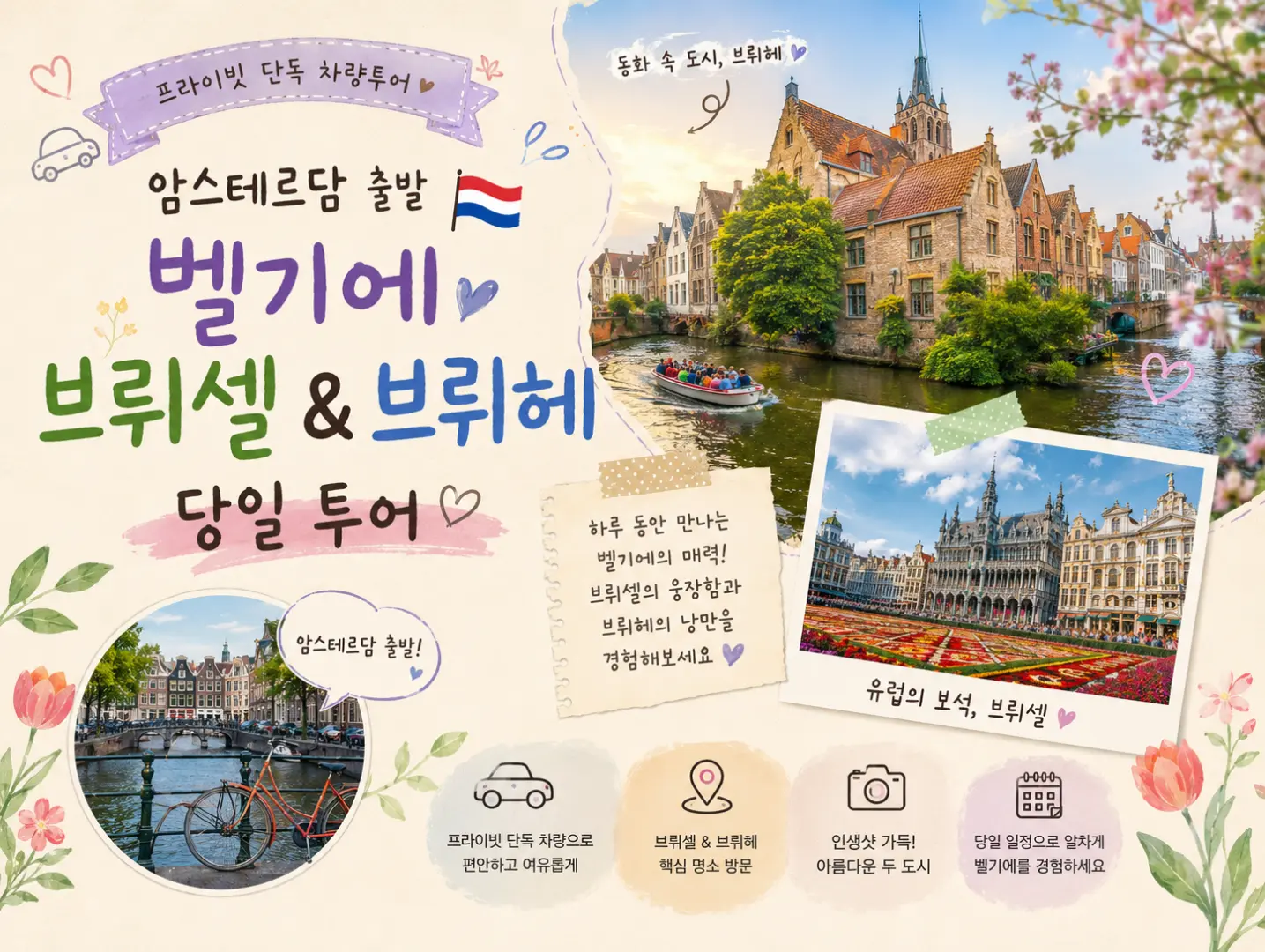
This is a tour product that allows you to enjoy two of Belgium's representative cities, Brussels, the city of art and romance, and Bruges, known as the little Venice of the north, starting from Amsterdam.
The tour departs from Amsterdam and travels to Brussels using a private vehicle. In Belgium, the city of art and romance, you can immerse yourself in its unique charm, which seems to combine splendid Art Nouveau architecture, various works of art, and characteristics from all over Europe in one place.
After the Brussels tour, we will move on to Bruges, the flower of Belgium. Bruges is a charming city where the entire area is designated as a UNESCO World Heritage Site. Please experience the charm of the Middle Ages as you walk along the picturesque scenery featuring elegant medieval Gothic buildings, spires rising throughout the city, and over 50 bridges spanning the canals.
Product Info
The content of this product is provided by machine translation and may not reflect the actual information, please take this into consideration before booking.
This is a tour product that allows you to enjoy two of Belgium's representative cities, Brussels, the city of art and romance, and Bruges, known as the little Venice of the north, starting from Amsterdam.
The tour departs from Amsterdam and travels to Brussels using a private vehicle. In Belgium, the city of art and romance, you can immerse yourself in its unique charm, which seems to combine splendid Art Nouveau architecture, various works of art, and characteristics from all over Europe in one place.
After the Brussels tour, we will move on to Bruges, the flower of Belgium. Bruges is a charming city where the entire area is designated as a UNESCO World Heritage Site. Please experience the charm of the Middle Ages as you walk along the picturesque scenery featuring elegant medieval Gothic buildings, spires rising throughout the city, and over 50 bridges spanning the canals.
- Brussels - Grand Place
A beautiful square said to have been praised by Queen Isabella of Spain, as well as Hugo and Baudelaire. A market was established in the 11th century by filling in the sandbar of the Seine River; it became a trading hub in the 12th century, and by the 14th century, wealthy merchants erected magnificent stone buildings. It was destroyed by Louis XIV in 1695 but was rebuilt over a period of five years in the early 18th century. Currently, a flower market is held daily, and a bird market takes place on Sundays. Additionally, colorful seasonal events are held here.
- Brussels - Manneken Pis (Manneken Pis)
The Manneken Pis (Dutch: Manneken Pis), a symbol of Brussels, is a bronze statue approximately 60 cm tall created by Jérôme Duquesnoy in 1619 and is also known as Little Julien (French: Petit Julien). Its origins lie in the 14th century, when a prince of the Duke of Fravand insulted enemy soldiers by urinating on the statue. Clothes are sent from around the world to dress the bronze statue, and it is occasionally dressed in them. Various of these outfits are displayed in the King's House.
- Brussels - Palais Royal Palace
In front is Brussels Park, where royalty enjoyed hunting in the 14th century. It serves as the official residence of the King of Belgium, with the national flag flying on the roof, and is still used for official business today. A fortress once stood here, but it was destroyed by fire in 1731. In 1829, the residence of William of Orange was built on the site, where he also conducted his official duties for a time. It was rebuilt by the Duke of Brabant in 1862, and the structure seen today was reconstructed by Leopold II around 1904.
- Bruges - Markt Square
The central square of Bruges is surrounded by the West Flanders Provincial Government Building, which is Neo-Gothic on three sides, the towering Belfort, and the Guild Houses that resemble chocolate cookies. Cafes line the front of the Guild Houses, and the bustling atmosphere here has become a famous feature of the square.
- Bruges-Belfort (Bell Tower)
Belforts built in medieval metropolises were typically constructed high as symbols of power, and this one is characterized by its octagonal top, resembling a wedding cake. Construction began in the 13th century, and the summit, reached by climbing 366 spiral stone steps, was completed at the end of the 15th century. Looking down from here, the entire streetscape, including the Markt, resembles a beautifully crafted miniature garden.
- Bruges - Basiliek Heiling Bloed Chapel of the Holy Blood
Its name originates from the fact that it houses the Holy Blood of Christ, which was brought from Constantinople by the Count of Flanders who participated in the Crusades. It was built around 1150, and the lower part, the ossuary of St. Basil, is in the Romanesque style, while the upper part was renovated in the Gothic style at the end of the 15th century.

Important Info
Reminders
A minimum of 1 traveler(s) are required for the tour to depart. If the number of participants does not reach the minimum requirement, the tour will be canceled. An email regarding tour cancellation will be sent 2 day(s) before the departure date
The vehicle is subject to change depending on the number of tour participants and availability.
Please make sure to arrive at least 10 minutes before the meeting time. The tour departs on time, and refunds or joining midway are not available for latecomers.
We will notify you in advance if there are any changes to the schedule due to local weather conditions, accidents, disasters, etc.
As the itinerary involves a lot of walking within the tourist attractions, please wear comfortable shoes.
FAQ
1. What historical and architectural highlights can visitors expect to see in Brussels?
Brussels, a city renowned for its art and romance, showcases a rich tapestry of historical and architectural wonders. Visitors can admire the ornate Art Nouveau style architecture prevalent throughout the city, reflecting its unique artistic heritage. The city also features a blend of diverse European characteristics, offering a captivating visual journey through its grand squares and artistic masterpieces.
2. Is a private car tour from Amsterdam the most efficient way to visit both Brussels and Bruges?
Opting for a private car tour from Amsterdam is highly efficient for visiting both Brussels and Bruges in a single day. This mode of transport offers unparalleled convenience, eliminating the complexities of public transportation schedules and transfers. It allows for a seamless, comfortable journey directly between destinations, maximizing sightseeing time in both Belgian cities without the hassle of self-driving.
3. What makes Bruges' medieval city center and canals a UNESCO World Heritage site?
Bruges' entire city center is designated a UNESCO World Heritage site due to its remarkably preserved medieval Gothic architecture, quaint charm, and picturesque canals. Often called the "Venice of the North," Bruges boasts over 50 bridges spanning its waterways, creating a fairytale-like landscape. Its historic buildings, rising spires, and tranquil canals beautifully illustrate a rich medieval past, offering a unique cultural experience.
4. What unique artistic and architectural styles define Brussels as a European capital?
Brussels is particularly renowned for its splendid Art Nouveau architecture, an artistic style characterized by organic forms, intricate details, and a focus on craftsmanship. Beyond Art Nouveau, the city also blends various European architectural elements, creating a unique urban landscape that reflects its status as a vibrant cultural and political hub. Visitors can discover a diverse array of artistic expressions and grand structures.
5. How does a full-day tour from Amsterdam typically cover both Brussels and Bruges?
A full-day tour from Amsterdam to Belgium, especially one using a private vehicle, typically begins with direct transport to Brussels to explore its main attractions. After a comprehensive visit there, the tour then proceeds comfortably to Bruges, known for its well-preserved medieval charm. This structure allows travelers to experience the distinct atmospheres and highlights of both cities, from Brussels' grandeur to Bruges' historic beauty, all within a single day.
6. What are the main differences between the visitor experience in Brussels and Bruges?
Brussels offers a grand, cosmopolitan experience with its impressive Art Nouveau architecture, diverse artistic scenes, and vibrant urban energy, making it a bustling European capital. Bruges, in contrast, provides a more intimate, fairytale-like journey back to the Middle Ages, characterized by its well-preserved Gothic buildings, tranquil canals, and pedestrian-friendly streets. Both cities offer unique charm and distinct cultural atmospheres for visitors.
7. What is the best way to experience Bruges' picturesque canals and Gothic buildings?
To fully experience Bruges' picturesque canals and Gothic buildings, walking is highly recommended to appreciate its UNESCO-listed medieval charm up close. Exploring on foot allows you to wander along the canals, discover hidden alleys, and admire the intricate architecture of its historic center. Additionally, canal boat tours offer a unique and relaxing perspective of the city's beauty and its numerous bridges from the water.
8. Are English and other common European languages widely understood by staff in Brussels and Bruges for tourists?
Yes, in both Brussels and Bruges, English is generally widely understood and spoken, especially in tourist areas, hotels, restaurants, and attractions. As these are popular European tourist destinations, staff in the service industry are accustomed to assisting international visitors. French and Dutch are also official languages in Belgium, with French more prevalent in Brussels and Dutch commonly spoken in Bruges.


