



Queen Hatshepsut Temple Tour With Memnon, Karnak & Luxor Temple
- Focus on Queen Hatshepsut Temple Tour with private guide.
- Start with Luxor Temple Tour in the ancient city area.
- Continue to Karnak Temple Tour during the East Bank route.
- Follow Avenue Of Sphinxes Tour according to local timing.
- Stop at Colossi Of Memnon Tour before Hatshepsut Temple.
- Combine East Bank temples with a West Bank temple visit.
- Select English, Italian, German, French, Spanish, or Russian.
- Book privately for 1 to 9 participants in your group.
- Choose tickets and lunch included or exclude both services.
- Pickup details are confirmed one day before your activity date.
Package Options
Product Info
Begin your private Luxor experience with pickup from your hotel or selected pickup point, then travel by private air-conditioned vehicle with your guide. This route is created for travelers who want a smooth full-day journey linking Luxor’s East Bank temple landmarks with the West Bank atmosphere of Colossi Of Memnon and Queen Hatshepsut Temple Tour. It is a focused itinerary for guests who prefer temples, ancient city routes, and guided interpretation without adding tomb valleys, museum stops, balloon rides, or Nile sailing unless booked separately. Transfer time may vary depending on your hotel location, and your final pickup details will be confirmed one day before your activity.
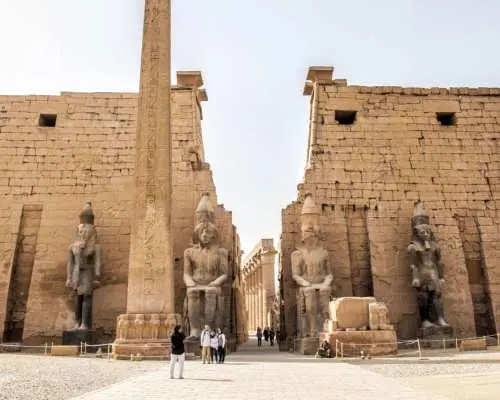
The day begins with Luxor Temple Tour. This first stop introduces the ancient city side of Luxor, where temple architecture and local surroundings create a strong opening to the experience. With your selected guide language, the visit becomes clearer and more organized. Your guide explains the site according to the confirmed package, ticketing process, site access, local operation, and daily timing.
After Luxor Temple, continue to Karnak Temple Tour. This section gives the East Bank part of the day a wider ancient scale. Karnak adds a different temple atmosphere, allowing guests to compare two important temple settings in one route. Your guide connects the experience naturally, helping guests understand the relationship between the East Bank landmarks while keeping the tour comfortable and focused.
The route also includes Avenue Of Sphinxes Tour according to confirmed timing and local access conditions. This section adds a historic link between the temple landscape and the ancient route associated with Luxor’s city heritage. The visit order may change due to traffic, site access, ticketing flow, prayer times, or daily operation, but the intended East Bank section remains focused on Luxor Temple, Karnak Temple, and the Avenue Of Sphinxes.
After the East Bank visits, continue toward the West Bank for Colossi Of Memnon Tour. This stop creates a strong change in atmosphere, moving from temple complexes to open monument scenery. The standing statues offer a memorable pause before the main West Bank temple visit and help connect the route to the wider landscape of ancient Luxor.
The main focus of the product is Queen Hatshepsut Temple Tour. This final major stop brings the day to a strong architectural and historical finish. The temple setting adds mountain-side atmosphere, structured design, and guided context after the East Bank temple visits and Colossi Of Memnon. Your guide explains the visit according to the selected language, confirmed package, site access, ticketing flow, and local timing.
Queen Hatshepsut Temple Tour With Memnon, Karnak & Luxor Temple
This main option follows the provided itinerary: Luxor Temple Tour, Karnak Temple Tour, Avenue Of Sphinxes Tour, Colossi Of Memnon Tour, and Queen Hatshepsut Temple Tour. After selecting the tour, guests can customize the booking through the available sub-options. Tour guide language can be selected from English, Italian, German, French, Spanish, or Russian. Participant number can be selected from 1 to 9 participants. Package type can be selected as with tickets and lunch included or without tickets and lunch.
If the with tickets and lunch package is selected, the listed required entry tickets and lunch are included according to the confirmed booking. Lunch location may vary depending on daily timing and operation, so guests should not expect one fixed restaurant. If the without tickets and lunch package is selected, the tour still includes private transport, guide service, and the guided route, but entry tickets and lunch are not included and must be paid separately if needed.
These selections apply only to the selected tour option, so guests should review the guide language, participant number, package type, and confirmed itinerary carefully before purchase. This product does not include Valley Of The Kings Tour, Valley Of The Queens Tour, Luxor Museum Tour, Luxor Mummification Museum, Luxor Hot Air Balloon Ride, Nile felucca ride, or extra temple stops unless clearly booked through another product.
Please ensure the phone number provided during booking is connected to WhatsApp for quick pickup and timing updates. If it is not connected to WhatsApp, kindly share an alternative number in advance.
Your tour begins with pickup from your hotel or selected pickup point. Transfer time may vary depending on your hotel location, and final pickup details are confirmed one day before the activity. After meeting your guide and driver, travel by private air-conditioned vehicle to begin the route. Start with Luxor Temple Tour according to the selected language, confirmed package, ticketing process, and site access. Continue afterward to Karnak Temple Tour, then follow Avenue Of Sphinxes Tour according to timing, access conditions, and local operation. After the East Bank section, continue toward the West Bank for Colossi Of Memnon Tour. Then visit Queen Hatshepsut Temple Tour according to site access, ticketing flow, local timing, and the confirmed package. Lunch is included only if the with tickets and lunch package is selected. If the without tickets and lunch package is selected, lunch is not included. Entry tickets are included only when the ticket-included package is selected. At the end of the tour, return by vehicle for drop-off.


Purchase Notice
- Please check the selected main option carefully before purchase.
- Sub-options apply only to the selected tour option.
- Available guide languages are English, Italian, German, French, Spanish, and Russian.
- Participant selection is available from 1 to 9 participants.
- Package type may be with tickets and lunch or without both.
- With tickets and lunch includes listed required entries and lunch.
- Without tickets and lunch excludes entry fees and lunch.
- Pickup time may vary depending on your hotel location.
- Final pickup details will be confirmed one day before the activity.
- Please provide a WhatsApp-connected phone number for updates.
- If your number has no WhatsApp, share an alternative number early.
- Temple access may depend on local operation and daily timing.
- Avenue access may depend on timing and local operation.
- Lunch location may vary according to daily operation and timing.
- Drinks and personal expenses are not included.
- Valley Of The Kings and Valley Of The Queens are not included.
- Museum visits and Nile sailing are not included.
- The visit order may change due to traffic or local operation.
- Comfortable shoes are recommended for temple walking areas.
- Queen Hatshepsut Temple Tour details depend on package.
How to Use
How to Use Your Voucher
- Please present the e-voucher on-site
FAQ
1. What is the historical significance of Queen Hatshepsut Temple in Luxor?
Queen Hatshepsut's Mortuary Temple is historically significant as a monumental tribute to one of Egypt's most powerful female pharaohs. Its unique design, cut into the cliffs, reflects her reign's stability and prosperity, serving as a testament to her legitimacy and divine right. The temple provides crucial insights into her life, achievements, and the religious practices of the New Kingdom era.
2. Is Queen Hatshepsut's tomb located within her temple complex?
While the Mortuary Temple of Queen Hatshepsut is a key memorial site, her actual burial tomb is located in the Valley of the Kings, separate from the temple complex. The temple itself was primarily dedicated to her cult and the god Amun-Ra, designed for posthumous worship and commemoration rather than as a direct burial site.
3. What can visitors expect to see at Queen Hatshepsut Temple?
At Queen Hatshepsut Temple, visitors can explore its impressive terraced architecture, intricately carved reliefs, and towering colonnades. These depictions illustrate scenes from Hatshepsut's divine birth, her expeditions to Punt, and her relationship with the gods. The temple offers a profound insight into ancient Egyptian art, architecture, and queenship, along with stunning cliffside views.
4. Where is Queen Hatshepsut Temple located, and how can it be reached as part of the tour?
Queen Hatshepsut Temple is located on the West Bank of the Nile in Luxor, nestled against the cliffs of Deir el-Bahari. As part of this private guided tour, you will travel by a private air-conditioned vehicle from your hotel or selected pickup point. This ensures comfortable and direct transportation to the temple after visiting the Colossi of Memnon, combining East and West Bank exploration.
5. How is transportation provided for visiting Queen Hatshepsut Temple and other East/West Bank sites during the tour?
Transportation for your tour is provided by a private air-conditioned vehicle with your selected guide. This service ensures comfortable and efficient transfers between all included sites: Luxor Temple, Karnak Temple, the Avenue of Sphinxes, the Colossi of Memnon, and Queen Hatshepsut Temple, spanning both the East and West Banks of Luxor. Pickup details are confirmed one day prior to your activity.
6. What are the main architectural highlights of Karnak Temple?
Karnak Temple is renowned for its vast scale and diverse architectural styles accumulated over centuries. Key highlights include the Great Hypostyle Hall with its 134 massive columns, the sacred lake, towering obelisks, and various pylons and chapels. Its sheer size and intricate details showcase the grandeur of ancient Egyptian temple construction, offering a comprehensive look at pharaonic worship.
7. What is the historical importance of the Colossi of Memnon?
The Colossi of Memnon are two colossal stone statues of Pharaoh Amenhotep III, serving as silent guardians of his massive funerary temple, which has long since vanished. Historically, they marked the grand entrance to one of the largest mortuary complexes of ancient Egypt. These imposing statues embody the pharaoh's power and divinity, standing as a poignant reminder of Luxor's rich past and ancient engineering.
8. What key features distinguish Luxor Temple from other ancient Egyptian temples?
Luxor Temple is distinguished by its unique orientation towards Karnak Temple, connected by the Avenue of Sphinxes, rather than directly facing the Nile. It was primarily a temple for festivals and was expanded by various pharaohs, including Amenhotep III and Ramesses II. Its open courts, towering colonnades, and detailed reliefs offer a different architectural experience, focusing on celebration and royal cult rituals.
Get Help


