

Salem and the witch trials self-guided walking audio tour
- Book now a self-guided tour to uncover the dark secrets of the Salem witch trials and hear detailed accounts of how it all transpired.
Package Options


Product Info
Purchase Notice
Reminders
Please refer to your voucher for final information regarding meeting points, pick-up locations, and pick-up time
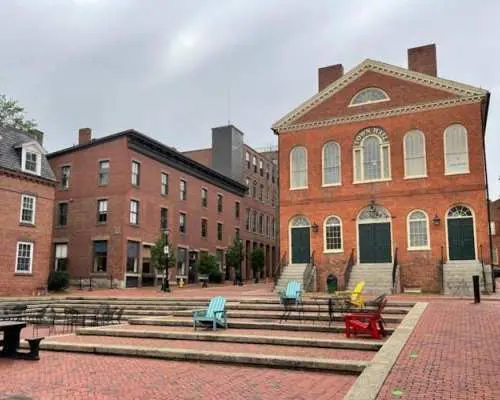
Meeting point description: The tour automatically begins playing when you reach the starting point. Start on New Liberty St in Salem, with the Salem Armory Visitor Center on your left and a multi-story car park on your right. This is the suggested starting point.(5 New Liberty St, Salem, MA 01970, USA)
Know in advance:This is a self-guided audio tour; no guide will accompany you and attraction tickets are not included. The app functions as a guide, an audio tour, and a map all in one
This experience is not affiliated with the Visitor Center or nearby businesses
After booking the tour, search your email for the phrase "Set up your self-guided tour now" and follow the instructions immediately to finish setting up the tour while you have Wi-Fi/data. Please don't wait until you are on-site
Most stops along the tour have animated videos allowing you to visualise what you cannot see, such as snapshots from different centuries or interior rooms
The audio stories play on their own based on your location. You can start anytime and pause anywhere
This tour has no expiration date. You can use it on any trip, as many times as you like
Works perfectly without cellular or Wi-Fi with offline maps
The tour requires a supported mobile device for navigation. Please use an iPhone with iOS 15 or later, an Android device with Android 9 or later, or an iPad/tablet with GPS and cellular service
Please bring your headphones and connect them before you begin, so you can hear the tour clearly throughout your experience.
FAQ
1. What were the primary underlying causes and origins of the Salem witch trials?
The Salem witch trials stemmed from a complex mix of factors in colonial Massachusetts. These included strong Puritan religious beliefs about the devil's influence, alongside social anxieties, economic tensions, and political instability in the region. A strict legal system that accepted "spectral evidence" and a community predisposition to mass hysteria further fueled the accusations against individuals.
2. How many individuals were executed during the Salem witch trials and for what reasons?
During the Salem witch trials, 20 individuals were executed. Nineteen were hanged, including 14 women and 5 men, after being found guilty of witchcraft. One man, Giles Corey, was pressed to death for refusing to enter a plea. Their executions were a direct result of convictions based often on questionable "spectral evidence" and coerced confessions, fueled by widespread fear and superstition.
3. What is known about the personal narrative and conviction of Rebecca Nurse during the Salem witch trials?
Rebecca Nurse, a 71-year-old respected and devout woman, was among the most prominent accused. Despite a jury initially finding her not guilty, public outcry led the magistrates to press for reconsideration, resulting in a guilty verdict. Her conviction was particularly controversial as many in the community testified to her good character, highlighting the profound injustices of the trials.
4. What were Sarah Good's final words before her execution during the Salem witch trials?
Sarah Good, a marginalized woman known for begging, was among the first accused and executed. Before her hanging, Reverend Nicholas Noyes urged her to confess. She defiantly stated, "You are a liar! I am no more a witch than you are a wizard, and if you take away my life God will give you blood to drink!" This stark refusal to confess highlighted her resistance amidst persecution.
5. Have there been any official apologies or acts of reconciliation for the events of the Salem witch trials?
Yes, there have been official acts of reconciliation. In 1711, the Massachusetts colonial legislature reversed the attainder (loss of civil rights) for some victims. Later, in 1957, Massachusetts formally apologized for the trials. Further legislation in 2001 posthumously cleared the names of the last five victims who had not been explicitly exonerated, marking significant steps toward acknowledgment and reconciliation.
6. Which individuals involved in the Salem witch trials expressed remorse or offered apologies for their roles?
Ann Putnam Jr., one of the key accusers among the "afflicted girls," publicly expressed remorse in 1706 for her role in the trials, stating she had been deluded by the devil. Judge Samuel Sewall, a magistrate during the trials, also publicly apologized in 1697 for his part, standing in church while his apology was read aloud, demonstrating significant personal accountability for the injustices.
7. What types of accusations and "spectral evidence" were commonly accepted during the Salem witch trials?
Accusations primarily involved alleged bewitchment, harming others through magic, or consorting with the Devil. "Spectral evidence," which was testimony about seeing the accused person's spirit (specter) tormenting the accuser, was widely accepted. Other "evidence" included physical marks on the body, coerced confessions, and testimonies from alleged "witches" claiming to have seen others with the Devil.
8. What were the lasting societal and cultural impacts of the Salem witch trials on American history?
The Salem witch trials left a profound legacy, deeply impacting American legal and cultural norms. They led to reforms in legal procedures, emphasizing due process and the rejection of spectral evidence. Culturally, the trials became a cautionary tale against mass hysteria, religious extremism, and injustice, influencing concepts of religious freedom and individual rights in the nascent nation.


