
![[Forbidden City & Jingshan Park] Knowledge Guide Tour with Teacher Nam -- Afternoon Special Lecture!](https://image.kkday.com/v2/image/get/c_fill%2Ch_800%2Cq_55%2Ct_webp%2Cw_1240/s1.kkday.com/product_scm_21052/20260522081819_MjAQv/jpg)
![[Forbidden City & Jingshan Park] Knowledge Guide Tour with Teacher Nam -- Afternoon Special Lecture!](https://image.kkday.com/v2/image/get/c_fill%2Ch_400%2Cq_55%2Ct_webp%2Cw_500/s1.kkday.com/product_scm_21052/20260522081822_EVRU8/jpg)
![[Forbidden City & Jingshan Park] Knowledge Guide Tour with Teacher Nam -- Afternoon Special Lecture!](https://image.kkday.com/v2/image/get/c_fill%2Ch_400%2Cq_55%2Ct_webp%2Cw_500/s1.kkday.com/product_scm_21052/20260522081824_fWd0i/jpg)
![[Forbidden City & Jingshan Park] Knowledge Guide Tour with Teacher Nam -- Afternoon Special Lecture!](https://image.kkday.com/v2/image/get/c_fill%2Ch_400%2Cq_55%2Ct_webp%2Cw_500/s1.kkday.com/product_scm_21052/20260522081828_50e0t/jpg)
![[Forbidden City & Jingshan Park] Knowledge Guide Tour with Teacher Nam -- Afternoon Special Lecture!](https://image.kkday.com/v2/image/get/c_fill%2Ch_400%2Cq_55%2Ct_webp%2Cw_500/s1.kkday.com/product_scm_21052/20260522081830_M0I6B/jpg)
[Forbidden City & Jingshan Park] Knowledge Guide Tour with Teacher Nam -- Afternoon Special Lecture!
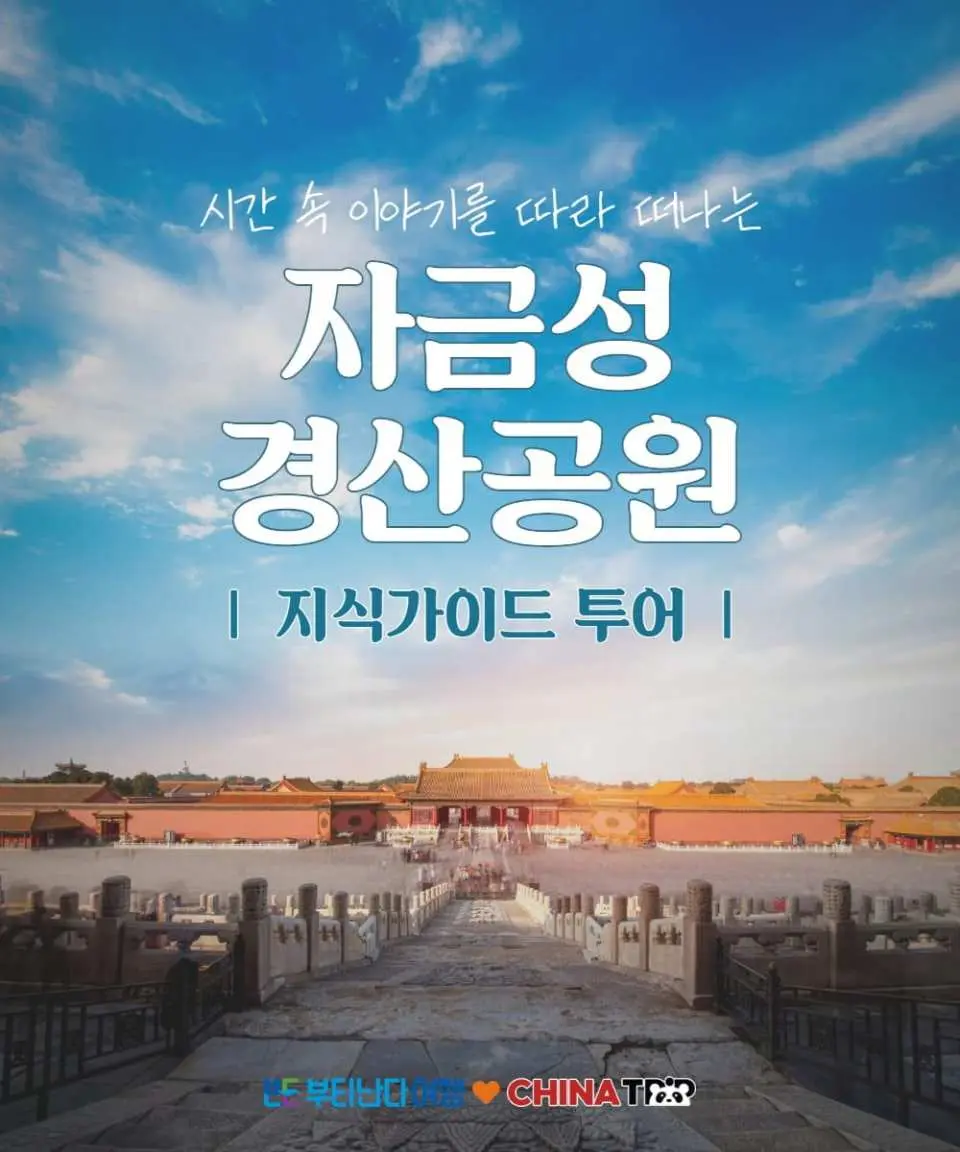
- The Forbidden City, once the city of the emperor, and Jingshan Park, which overlooks the scenery from the closest vantage point.
Package Options


Product Info
The content of this product is provided by machine translation and may not reflect the actual information, please take this into consideration before booking.
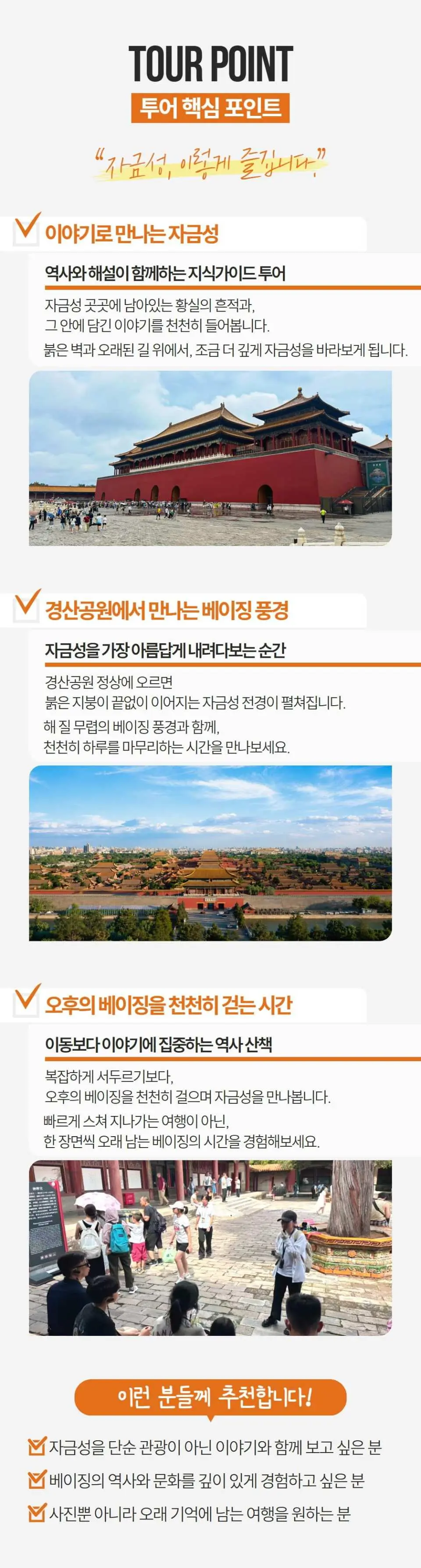
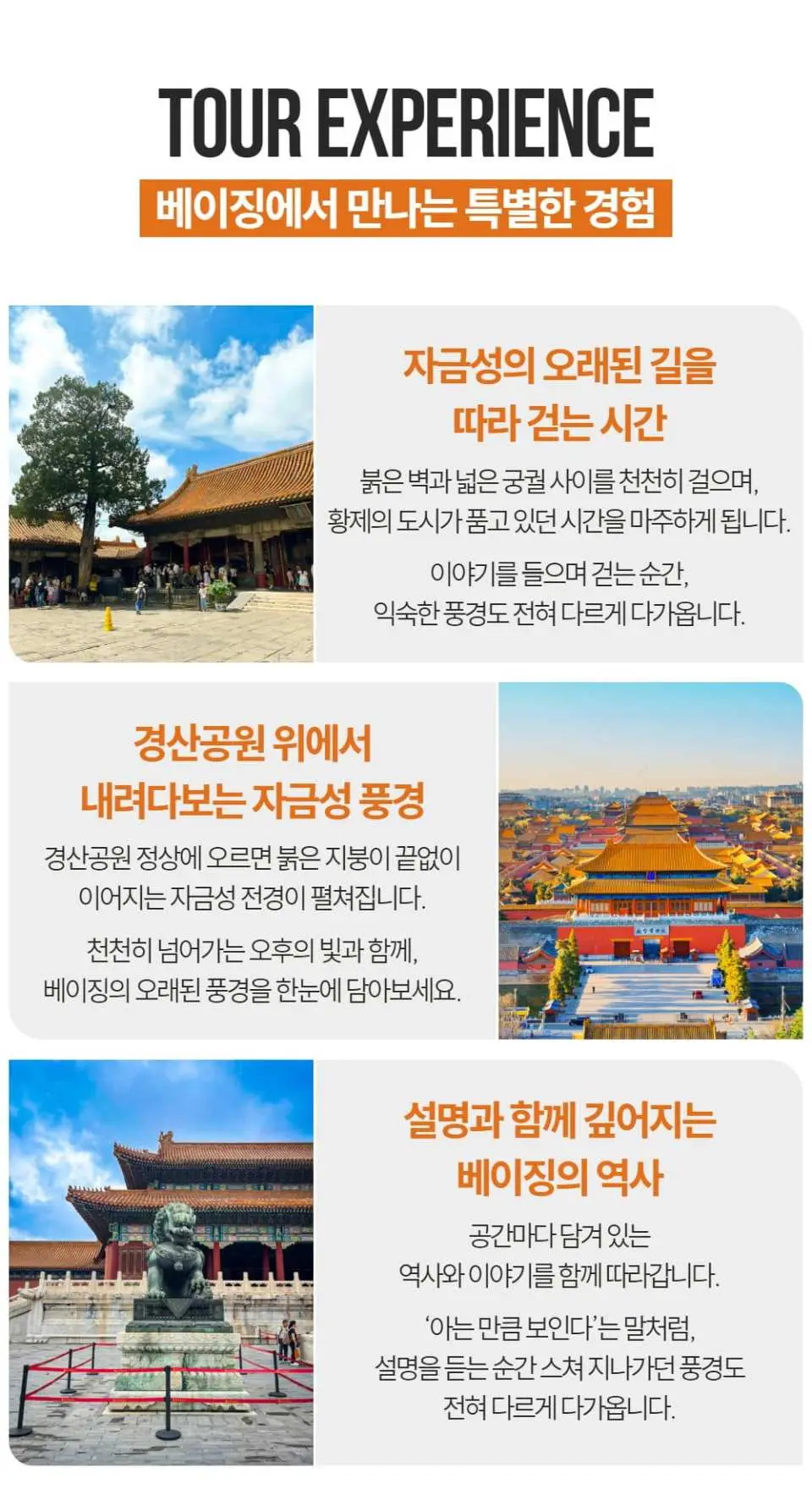
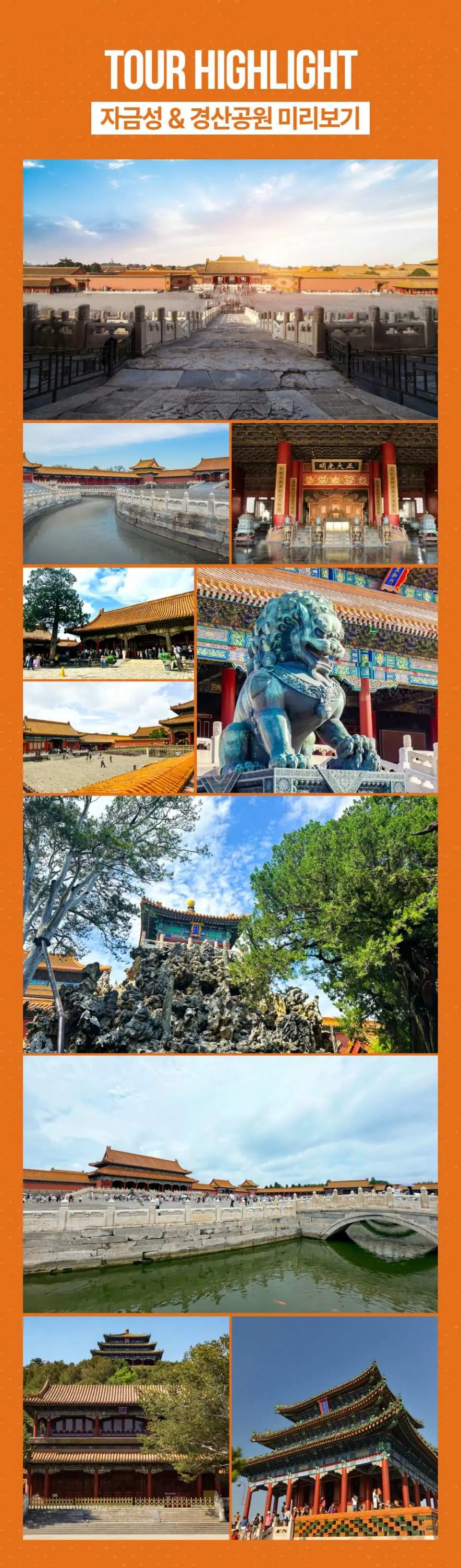
- As you walk slowly between the red walls and vast palaces of the Forbidden City, you come face to face with the time held within the Emperor's City. As you walk while listening to the stories, even familiar scenery takes on a completely different feel.
- When you reach the summit of Jingshan Park, a panoramic view of the Forbidden City unfolds, with its endless rows of red roofs. Take in the ancient scenery of Beijing at a glance, accompanied by the slowly fading afternoon light.
- Experience the deepening history of Beijing accompanied by explanations. Follow the history and stories contained in each space.










Purchase Notice
- This tour is confirmed to depart with a minimum of 4 reservations.
- Tours are not conducted every Monday as the Forbidden City is closed.
- Children 120cm or taller are charged the adult rate, while those under 120cm are charged the child rate. (Height is measured on the day of the tour while wearing shoes; if the standard is exceeded, the difference will be charged on-site.)
- The tour order or schedule is subject to change depending on local traffic conditions, weather, etc.
- Please strictly adhere to the meeting time. (If you are late for the meeting without prior notice, we will depart without further notice.)
- Refunds are not available for non-attendance due to traffic congestion, a mistake regarding the meeting location, or personal reasons.
- Your reservation is not confirmed until you receive a confirmation notice, and it may be unavailable or refunded depending on local circumstances.
- Tickets for the Forbidden City for this tour are issued sequentially starting 7 days before the tour date, in accordance with the tourist attraction's policy.
- Forbidden City tickets may sell out early during peak season, and 100% ticketing is not guaranteed.
Reminders
A minimum of 4 traveler(s) are required for the tour to depart. If the number of participants does not reach the minimum requirement, the tour will be canceled. An email regarding tour cancellation will be sent 3 day(s) before the departure date
FAQ
1. What is the official English name for the Forbidden City?
The official English name for this historic imperial palace complex is the "Forbidden City." It is also widely known as the "Palace Museum" in Beijing, which reflects its current function as a vast museum housing invaluable imperial collections and artifacts, open to the public.
2. What is the historical meaning behind the name 'Forbidden City'?
The name "Forbidden City" historically signifies its highly restricted status during imperial times. It served as the exclusive residence for the Emperor and his family, and the central administrative hub of imperial China. Unauthorized entry was strictly prohibited to anyone outside the imperial household, underscoring the Emperor's absolute power.
3. What was the primary reason for the establishment and construction of the Forbidden City?
The Forbidden City was primarily established by Emperor Yongle of the Ming Dynasty to solidify his reign and relocate the capital from Nanjing to Beijing. Its magnificent scale and intricate design were intended to project immense imperial power, authority, and the Emperor's central role as the Son of Heaven, ruling the vast empire from this grand complex.
4. Why are there notably few trees within the main courtyards of the Forbidden City?
The deliberate absence of trees in the vast main courtyards of the Forbidden City served several strategic and symbolic purposes. It provided clear sightlines for guards to enhance security against potential assassination attempts, emphasized the solemn and imposing atmosphere of the imperial court, and symbolically highlighted the architectural grandeur over natural elements. Trees were more common in the private residential areas and gardens.
5. Where is the Forbidden City located, and what is its geographical significance?
The Forbidden City is centrally located in Beijing, China, positioned precisely on a north-south axis. Its strategic placement in the heart of the capital reflects its historical role as the administrative and ceremonial center of imperial power. This axial alignment is a fundamental principle in traditional Chinese urban planning and cosmology, emphasizing the Emperor's central and divine status.
6. What are the key characteristics of the Forbidden City, originally built by Emperor Yongle?
The Forbidden City, originally commissioned by Emperor Yongle, is renowned for its immense scale, precise symmetrical layout, and distinctive traditional Chinese imperial architecture. Key characteristics include its yellow glazed roof tiles, symbolizing the emperor, and vibrant red walls, representing good fortune. The complex is structurally divided into outer courts for state ceremonies and inner courts for residential functions, encompassing over 980 buildings.
7. What is the significance of Jingshan Park in relation to the Forbidden City?
Jingshan Park, situated directly to the north of the Forbidden City, holds significant historical and geographical importance. The park's highest point, a man-made hill, offers unparalleled panoramic views of the entire Forbidden City complex, allowing visitors to appreciate its vast scale and intricate layout from above. Historically, it formed part of the imperial gardens and provides a natural contrast to the palace's grand architecture.
8. When was the construction of the Forbidden City originally completed, and how long did it take?
The construction of the Forbidden City commenced in 1406 and was largely completed by 1420, a monumental undertaking that spanned approximately 14 years. This massive project required the efforts of over a million laborers and artisans, utilizing materials sourced from across China to create one of the world's most impressive imperial palace complexes.


