Please kindly recheck the pickup details, meeting point, and session time stated on the voucher for your selected package.
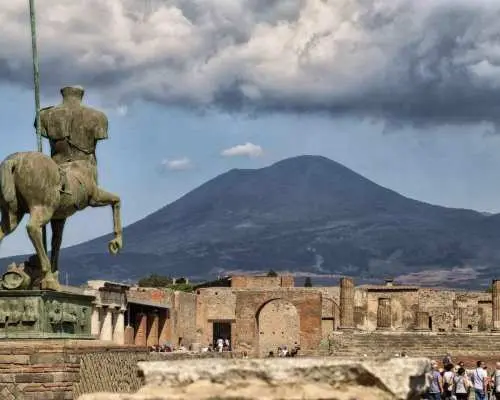
Tourists will be picked up by a private tourist bus and taken to discover the archaeological excavations of Pompeii, a UNESCO heritage site since 1997 and the third most important in the world. The tour, with a certified tourist guide, will take them on a visit to the most faithful reproduction of a Roman city, thanks to the state of preservation brought about by the layer of lava and ash that covered the city at the time of the volcanic eruption of Mount Vesuvius in 79 AD. The houses, the shops, the forums with the public buildings, the Roman amphitheatre with the Stabian Baths and the temples, up to the patrician villas and the Lupanare, will take tourists on a tour of the ancient city of Pompeii, catapulting them into that now lost civilisation and giving them a taste of the way of life of an era two thousand years old.
Tourists entering directly from Porta Marina will visit the Suburban Baths, known for the erotic frescoes of the Apodyterium (dressing room). Their location is no coincidence, as they were built outside the walls not only to attract people from the city, but also visitors passing through.
It is a public bath complex from the Augustan period, with male and female changing rooms and erotic-themed frescoes promoting events that took place in the rooms on the upper floor. Other baths are decorated with mosaics and paintings depicting cupids, naval battles and sea animals.
In the life of the Pompeians, the baths were sacred, an indispensable daily ritual, a place for relaxation, but also for discussions of politics or private life.
Moving up towards the Forum, one can visit the House of the Faun, the largest and most spectacular of the patrician domus. Built in the 3rd century B.C., the house housed the famous statue of the Dancing Faun, now on display in the Archaeological Museum of Naples. The house consists of two courtyards with porticoes, baths, dining rooms and reception rooms, all enriched with valuable mosaics and frescoes.
On Via del Vesuvio you can then visit the Domus degli Amorini Dorati or admire the fresco of Leda and the swan in the house of the same name.
Continuing on our way, we encounter the Basilica, a space for business and judicial administration. Conceived as a kind of Forum, but indoors, the same functions were carried out there in bad weather. On one side was the tribunal with the judge's bench elevated above the parties and accessible only by a wooden staircase, to prevent the magistrate from being attacked by the condemned.
Along this route, one can also admire the famous House of the Vettii, with its magnificent frescoes and mosaics, and the Small Theatre, where theatrical and musical performances were held. The route ends at the House of Menander, where there is the famous mosaic depicting the great Greek playwright.