


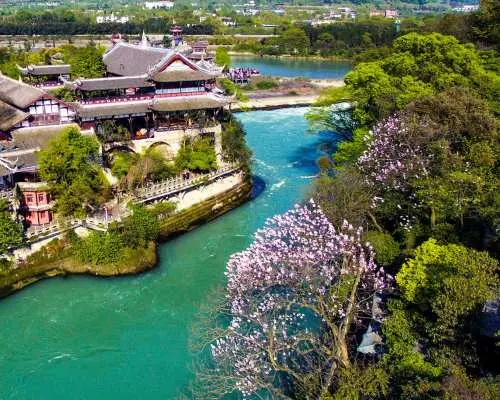


Chengdu, Sichuan | Dujiangyan Scenic Area
- World Cultural Heritage: Understanding Ancient Wisdom
- Cool climate, a summer resort
- Convenient transportation, suitable for independent travel
Package Options
Product Info
The content of this product is provided by machine translation and may not reflect the actual information, please take this into consideration before booking.
The Dujiangyan Irrigation System, located on the Minjiang River in the western Chengdu Plain, was built in 256 BC. Composed of the Fish Mouth Weir, Feisha Weir, and Baopingkou (Bottle-Neck Pass), it is the oldest and only surviving large-scale irrigation project in the world that features damless water diversion. It was officially listed as a "World Irrigation Engineering Heritage" site in 2018 and has been in continuous operation for 2280 years.
Business Hours
- November 1st to March 1st of the following year
08:00 - 17:30 (Ticket sales stop at 17:00)
- March 2nd - October 31st each year
08:00 - 18:00 (Ticket sales stop at 17:30)


Purchase Notice
1. This scenic area implements a "real-name registration" system for online ticket purchases. When placing an order, please fill in the ID card number for each person.
2. If your ID number is entered incorrectly or is demagnetized, please use the dedicated equipment at the ticket gate to verify your ID number before entering the park, or you may need to cancel your ticket and purchase a new one (please bring your ID for fast and convenient entry).
3. Tickets are valid only on the day of visit and will expire after that date. Please note that the ID used to collect the tickets must be the same person who booked the tickets.
How to Use
How to Use Your Voucher
- Please present your e-voucher and passport on-site
Experience Location
Location Name: Dujiangyan Scenic Area
Address: Dujiangyan Scenic AreaMonday 08:00–17:30
Tuesday 08:00–17:30
Wednesday 08:00–17:30
Thursday 08:00–17:30
Friday 08:00–17:30
Saturday 08:00–17:30
Sunday 08:00–17:30
Ticket checking will stop at 17:00
FAQ
1. Are tickets for the Dujiangyan Scenic Area required, and do they need to be booked in advance?
Tickets are generally required for entry to the Dujiangyan Scenic Area. While same-day purchases might be possible, it is often recommended to book your tickets in advance, especially during peak seasons or holidays, to ensure smooth entry and avoid potential queues. You can conveniently book your tickets through platforms like KKday, which offers a streamlined process and helps secure your entry, allowing you to focus on enjoying the historical site without hassle.
2. What is the recommended visit duration for the Dujiangyan Scenic Area?
To fully appreciate the Dujiangyan Scenic Area and its profound historical significance, a visit duration of approximately 3 to 4 hours is generally recommended. This allows sufficient time to explore key components like Yuzui (Fish Mouth Weir), Feishayan (Flying Sand Weir), and Baopingkou (Bottle-Neck Channel), understand the ancient irrigation system, and enjoy the natural surroundings at a relaxed pace.
3. What are the transportation options to reach the Dujiangyan Scenic Area from Chengdu?
The Dujiangyan Scenic Area is conveniently accessible from Chengdu. You can take a high-speed train from Chengdu Xipu Station or Chengdu North Station directly to Lidui Park Station (離堆公園站) in Dujiangyan, which is a short walk from the scenic area entrance. Alternatively, long-distance buses are available from several bus stations in Chengdu, such as Chadianzi Bus Station, offering direct routes to Dujiangyan City.
4. Is there metro access available to the Dujiangyan Scenic Area?
The Dujiangyan Scenic Area does not have a direct metro station within Dujiangyan City itself, as it's a separate city from Chengdu. However, the high-speed rail (CRH) line from Chengdu functions as a highly convenient public transport link, with services stopping at Lidui Park Station, which is located just a short walk from the scenic area's main entrance.
5. Can visitors travel to the Dujiangyan Scenic Area by high-speed rail?
Yes, visitors can conveniently travel to the Dujiangyan Scenic Area by high-speed rail. Trains depart regularly from Chengdu's Xipu Station and Chengdu North Station, taking approximately 30-40 minutes to reach Lidui Park Station (離堆公園站) in Dujiangyan. This station is located very close to the scenic area's entrance, making it a highly recommended and efficient travel option for a day trip.
6. Is the Dujiangyan Irrigation Project recognized as a World Heritage site?
Yes, the Dujiangyan Irrigation Project holds significant global recognition. It was officially listed as a 'World Irrigation Engineering Heritage' in 2018. Furthermore, it is part of the Mount Qingcheng and Dujiangyan Irrigation System, which was collectively inscribed as a UNESCO World Cultural Heritage site in 2000, underscoring its profound historical and engineering value.
7. What makes the Dujiangyan Irrigation Project a significant historical and engineering marvel?
The Dujiangyan Irrigation Project is an extraordinary engineering marvel built in 256 BC. Its significance lies in its ingenious design, featuring a dam-free diversion system comprising components like Yuzui (Fish Mouth Weir), Feishayan (Flying Sand Weir), and Baopingkou (Bottle-Neck Channel). It is the world's oldest and only continuously operating large-scale water conservancy project of its kind, having functioned for over 2280 years, showcasing remarkable ancient Chinese wisdom in water management.
8. What is the best season to visit the Dujiangyan Scenic Area for its cool climate and historical exploration?
For those seeking a cool climate and comfortable conditions for historical exploration, the Dujiangyan Scenic Area is particularly pleasant during spring (April to May) and autumn (September to October). These seasons offer mild temperatures, lush scenery, and fewer crowds compared to the peak summer months. While it is known as a summer resort for its relatively cooler temperatures, spring and autumn provide an optimal balance for extended outdoor sightseeing.


