


Half-Day Cu Chi Tunnels Tour From Ho Chi Minh City|English/Chinese-Speaking Tour Guide|Vietnam
- Learn about wartime life: Discover how people lived, worked, and even had hospitals and schools within the tunnels
- See war remnants: Observe remnants of booby traps, tanks, and other wartime artifacts
- Optional shooting range: You can have the chance to try firing an AK-47 (at an additional cost).
Package Options


Product Info
What to expect
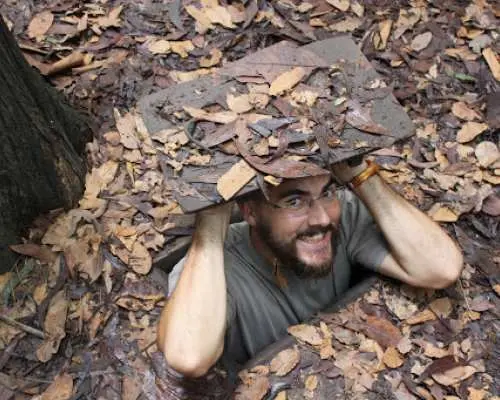
Join our journey to the legendary Cu Chi Tunnels - a testament to Vietnamese courage and ingenuity. Travel through the countryside before watching an engaging documentary revealing how the tunnels were built and how people endured life underground. Explore the intricate network of living quarters, kitchens, storage rooms, field hospitals, and command centers, uncovering the daily realities of wartime survival. Discover hidden trapdoors and ingenious defenses, then taste traditional tea and cassava - the simple yet symbolic “guerrilla food” of the era. For an added thrill, unwind or test your aim at the optional shooting range before returning to Ho Chi Minh City with a deeper appreciation of Vietnam’s remarkable resilience.
Important info
- Meeting time: 07.30 am for morning tour OR 12.30 pm for afternoon tour
- Duration: 6 hours
- Returning time: 02.30 pm for morning tour OR 07.30 pm for afternoon tour
- Pick-up zone: Hotels within center of District 1, Ho Chi Minh City (Except for Da Kao and Tan Dinh ward). If your hotel is outside of our pickup zone, please make your own arrangement to our meeting point in District 1 to join the tour
Eye-opening journey into the Cu Chi Tunnels' intricate underground world. Explore sections of this vast network, learn about wartime life within the tunnels, and gain a firsthand understanding of Vietnamese resilience. See remnants of the war and hear stories from knowledgeable guides, offering a powerful glimpse into this pivotal period of history.


Important Info
Reminders
A minimum of 2 traveler(s) are required for the tour to depart. If the number of participants does not reach the minimum requirement, the tour will be canceled. An email regarding tour cancellation will be sent 2 day(s) before the departure date
Please arrive at the designated location 15 minute(s) before the scheduled departure time, as the tour will depart on time
Meals are not included for children under the age of 3
We provide free pick-up and drop-off for hotels within center of District 1, Ho Chi Minh City (Except for Da Kao and Tan Dinh ward). If your hotel is outside of our pickup zone, please make your own arrangement to our meeting point in District 1 to join the tour
One day before your travel date, our operator will contact you via KKDay Chat to provide meeting instructions and confirm your pick-up time. We look forward to meeting you at the pick-up point on time. As this is a shared tour, the driver will only be able to wait for a maximum of 5 minutes beyond the scheduled pick-up time.
FAQ
The Cu Chi Tunnels hold immense historical significance as a vital strategic location during the Vietnam War. This vast underground network allowed Viet Cong soldiers to move undetected, house troops, transport supplies, and launch surprise attacks against American forces. It showcased their resilience and ingenuity, playing a crucial role in their resistance efforts and ultimately contributing to the outcome of the war.
Visitors to the Cu Chi Tunnels can explore various aspects of wartime life and the tunnel system. You can crawl through a safe, enlarged section of the tunnels, see hidden booby traps, explore underground living quarters, and observe command centers. There are also displays of historical artifacts, war remnants like tanks, and explanations of how the Viet Cong lived and fought during the conflict.
Visiting the Cu Chi Tunnels is highly worthwhile for first-time visitors to Vietnam, offering profound insight into the country's wartime history and the extraordinary resilience of its people. It provides a unique educational experience, allowing you to physically connect with a significant historical site and understand the strategies and daily life during the conflict. It's an impactful and memorable experience.
A typical Cu Chi Tunnels tour from Ho Chi Minh City usually takes about half a day, including travel time. The actual time spent exploring the tunnels and attractions at the site is generally around 2 to 3 hours. This allows ample time to visit the various sections, learn about the history, and participate in available activities.
The most recommended ways to reach the Cu Chi Tunnels from Ho Chi Minh City are by organized tour bus or private car. Tour buses offer convenience with included transportation and a guide. Alternatively, you can hire a private car or taxi for more flexibility, with the journey taking approximately 1.5 to 2 hours, depending on traffic. Public buses are also an option but require transfers and longer travel times.
Yes, visitors can indeed experience crawling through a section of the Cu Chi Tunnels. Some tunnel segments have been widened to accommodate tourists for a brief, immersive experience. Additionally, an optional shooting range is available at the site where visitors can try firing various weapons, such as an AK-47, typically at an additional cost.
You can conveniently book a tour to the Cu Chi Tunnels through various online travel platforms. For instance, booking through KKday provides a streamlined process, often including round-trip transportation from Ho Chi Minh City, an English-speaking tour guide, and hassle-free entry, ensuring a well-organized and informative visit without the need for complex planning.
The Cu Chi Tunnels complex has two main sites accessible to tourists: Ben Dinh and Ben Duoc. Ben Dinh is closer to Ho Chi Minh City and more popular, with some tunnel sections slightly enlarged and reinforced for visitor safety and ease of access. Ben Duoc offers a more authentic, less altered experience with narrower tunnels, providing a deeper understanding of the original conditions faced by soldiers. Both sites are well-maintained for public viewing.
Get Help


