


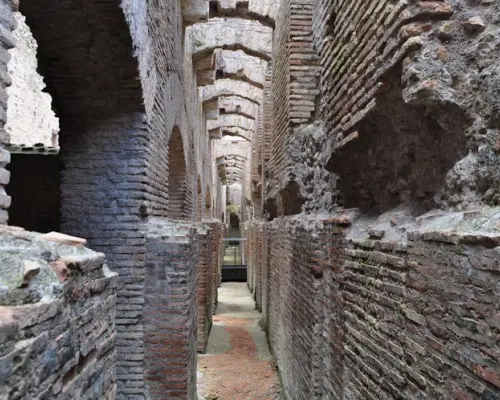

Colosseum, Underground and Roman Forum exclusive small group tour
- Book an exclusive tour of the Roman Forum and the Colosseum, including its underground sections, with a small group of no more than 6 participants.
Package Options


Product Info
Purchase Notice
Reminders
Please refer to your voucher for final information regarding meeting points, pick-up locations, and pick-up time
Meeting point description: In front of Caffè Roma, look for your guide holding a sign with 'Eyes of Rome Semi-Private Tours' written on it. Please arrive 15 minutes before the tour start time.(Caffè Roma, Via del Colosseo, 31, Rome, Italy)
Accessibility:Not suitable for wheelchair users and those with mobility issues due to stairs and uneven ground
Not allowed:Large bags, backpacks, and bulky items are not allowed inside the Colosseum
Photography is allowed, but tripods and selfie sticks may be restricted
Know in advance:Admission to the Colosseum and Roman Forum with Underground access costs €24 per person, while the Colosseum reservation fee is €2 (+VAT 0.44€) per person (already included in the tour price). The price difference is due to the additional services included in the offer (professional guide, individual headsets, customer support, and other related services)
Remember to check the Visitor Regulations of the Colosseum Archaeological Park available on the official website of the venue. Please note that you are required to comply with all the provisions set out in those regulations
The tour is limited to a maximum of 6 participants per group
Remember to bring:Your original passport/ID - a double check will be done by the Colosseum staff. If one or more IDs are missing, access to the Colosseum will be denied
Closed-toe, non-slip shoes are required for safety. Access to the Colosseum may be denied without proper footwear
FAQ
1. How many people and animals were sacrificed during the Roman Colosseum's spectacles?
The spectacles at the Roman Colosseum, particularly the gladiator contests, were a major form of entertainment during the Roman Empire. These events led to the deaths of hundreds of thousands of gladiators, prisoners, and condemned individuals. Simultaneously, to satisfy the demand for combat, hundreds of thousands of wild animals, including lions, tigers, bears, and elephants, were slaughtered in the arena. These bloody sacrifices were an integral part of Roman society and culture, reflecting the values of the time.
2. Why is the existing structure of the Colosseum incomplete?
The incomplete state of the Colosseum is the result of time and multiple factors. After the decline of the Western Roman Empire, the arena was used as housing, workshops, a fortress, a quarry, and a Christian shrine. During the Renaissance, much of its stone was dismantled to build other structures in Rome, such as St. Peter's Basilica and palaces. Earthquakes also severely damaged its structure, ultimately leading to its current ruined appearance.
3. How long does a typical visit to the Colosseum take?
A superficial visit to the Colosseum itself takes about 1 to 1.5 hours. If you wish to explore in depth and understand its historical background, especially by joining a guided tour (e.g., one that includes the underground and Roman Forum), it is recommended to allocate 2.5 to 3 hours. This will give you ample time to view each area carefully and fully absorb the guide's explanations.
4. In which country and city is the Colosseum located?
The Colosseum is located in Rome, the capital city of Italy. It is one of the most iconic structures of the ancient Roman Empire, situated in the heart of Rome, near the Roman Forum and Palatine Hill. It is a must-visit landmark for tourists in Rome. Its unique geographical location makes it a symbol of the convergence of historical and modern Rome.
5. What are the unique highlights of the Colosseum's underground area?
The underground area of the Colosseum (Hypogeum) served as the backstage where gladiators and beasts prepared to enter the arena. Highlights here include the remains of complex elevator and ramp systems used to transport gladiators and animals to the arena floor. You can personally experience how it operated, imagine the tension of gladiators waiting in the darkness before their appearance, and gain a deep understanding of the engineering and brutal history behind the amphitheater.
6. What significant historical ruins can be seen when visiting the Roman Forum?
By visiting the Roman Forum, you can witness the center of ancient Roman political, religious, and commercial life. Significant historical ruins here include triumphal arches (like the Arch of Titus and the Arch of Septimius Severus), the Senate House, the Temple of Vesta, the Temple of Saturn, and the ruins of Roman emperors' palaces. These remaining architectural complexes offer an opportunity to delve into the glorious history of Roman civilization and are a treasure trove for archaeology and history enthusiasts.
7. What special construction methods or materials were used in the Colosseum's architecture?
The architecture of the Colosseum primarily utilized Roman concrete, tuff, and travertine marble. Its unique arched structural design, combining strong concrete with an outer layer of travertine, allowed it to withstand immense weight and maintain stability. These innovative techniques showcase the exceptional ingenuity of ancient Roman engineers, making it the largest and most advanced amphitheater in the world at that time.
8. Besides being an arena, what other uses did the Colosseum serve historically?
The Colosseum underwent various transformations in its historical uses. After the decline of the Western Roman Empire, it was converted into a fortress for defense against external invasions. During the Middle Ages, parts of it were used as a cemetery and small residential areas. Furthermore, it served as a quarry, with its stones being extensively dismantled for the construction of other buildings within Rome. It was only in modern times that it was revalued as a cultural heritage site for protection and restoration.


