


Alice Springs to Uluru Transfer & Scenic Tour | Darwin
- Reach Ayers Rock Resort by early afternoon, ideal for beginning your Uluru adventure
- Enjoy a comfortable journey with onboard amenities from Alice Springs to Ayers Rock Resort
- Explore the amazing UNESCO World Heritage-listed Uluru-Kata Tjuta National Park
- Learn about the region’s natural, geological, and cultural history from your expert Driver Guide
- Pass through these impressive mountain ranges, an essential feature of Central Australia’s landscape
Package Options


Sightseeing Tours
| Tour Type | Shared tour |
| Transportation method | Transfer from meeting point |
| Luggage limit | 1 piece |
| Tour types | Guided tour |
| Additional service & facility | Transfer included |
| Sightseeing type | Natural sights, Bus tour |
| Transport | Bus tour |
Product Info
— What You Can Expect —
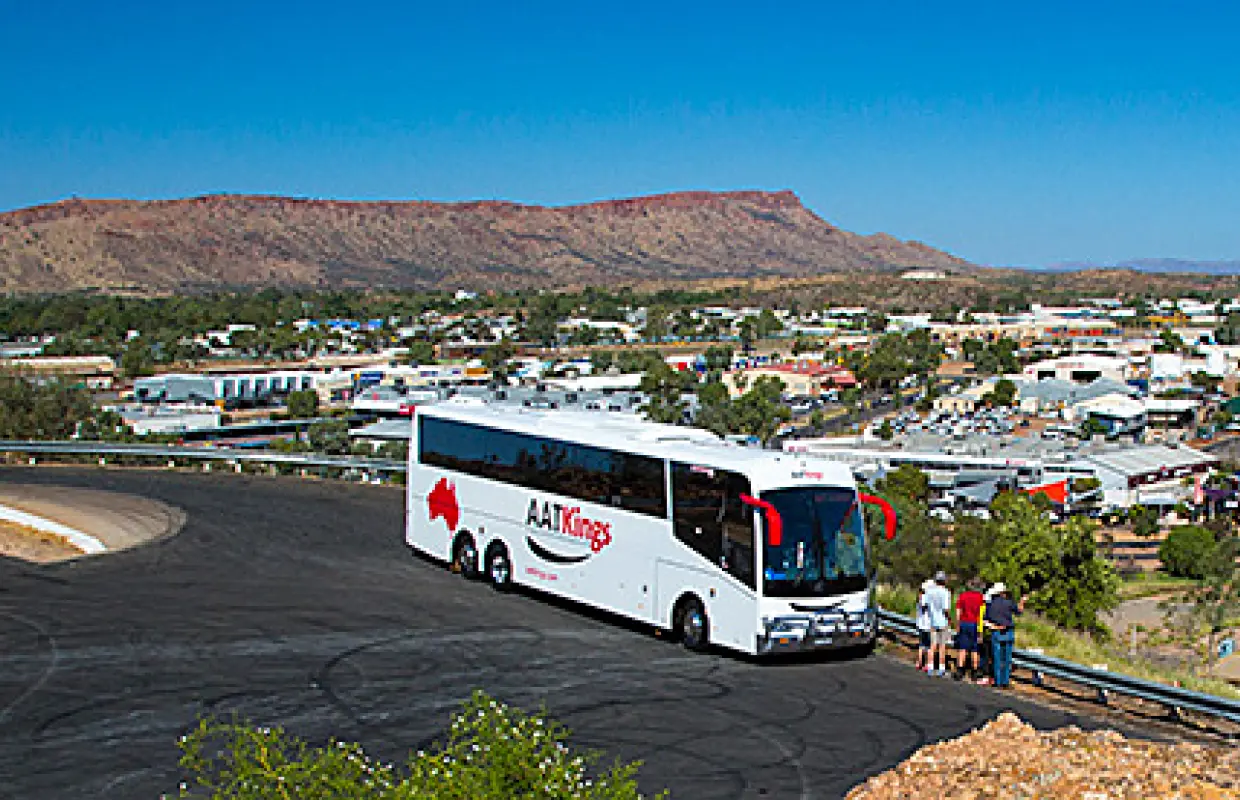
Embark on a memorable journey from Alice Springs to Uluru aboard a luxury AAT Kings coach, where comfort and adventure blend seamlessly.
Departing in the early morning, travelers can enjoy a relaxed drive through the captivating landscapes of Australia’s Red Centre, surrounded by the rugged beauty of the MacDonnell Ranges. En route, your expert guide shares fascinating insights into the natural and geological history of the area, along with the unique flora and fauna of the desert and the cultural traditions of the local Aboriginal people.
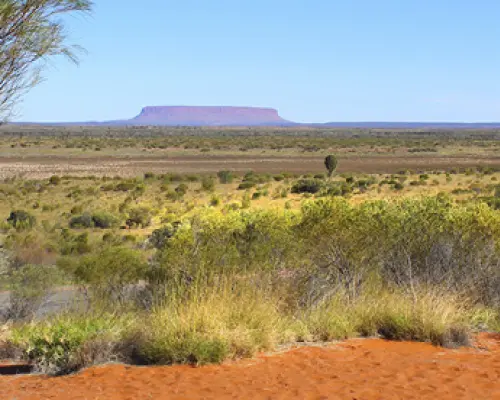
Marvel at the impressive sight of flat-topped Atila (Mt. Conner) rising in the distance before arriving at Ayers Rock Resort, ready to explore the iconic Uluru-Kata Tjuta National Park.
Embark on an amazing journey and explore the Uluru region with a luxury coach


Enjoy the rugged desert scenery and delve deeper into the traditional customs and ancient beliefs of the local indigenous population


Take a quick break at a local roadhouse and enjoy the view of flat-topped Atila (Mount Conner) in the distance


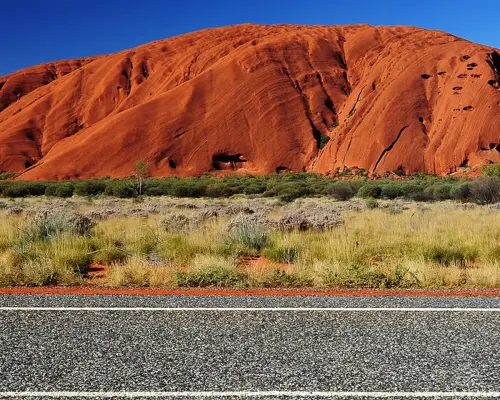
Marvel at the blushing ruby colors of Ayers Rock while exploring the world heritage-listed site Uluru-Kata Tjuta National Park


Route map


Purchase Notice
- Please note that entry into the national park requires an NT Pass, Kakadu, or Uluru-Kata Tjuta National Park pass. More details on purchasing a pass can be found HERE. Kindly ensure you acquire the necessary pass before booking
- Please refer to voucher for final confirmation of pick up location/ time
- Please re-confirm 24 hours before your trip departs to ensure your desired pick-up location will be on the coach route
- If you do not receive an SMS from AAT Kings to confirm your pick up time, please call 1300 228 546 (option 1) to reconfirm and ensure you will meet the coach at the right time
- Due to limited motorcoach capacity, each passenger is allowed one bag with dimensions not exceeding 30"x18"x10" (76x46x25cm) and a weight limit of 20kg/44lbs. Carry-on luggage is limited to one piece per person, with maximum dimensions of 12"x11"x6" (30x28x14cm), which must fit under the seat or in the small overhead compartment
- A low level of fitness is required for the tour
- When booking with KKday, guest agrees to the T&C outlines here
— What to Bring —
- Sunglasses, sunscreen and hat
- Water bottle
- Warm layers in cooler months
Reminders
Please arrive at the designated location 10 minute(s) before the scheduled departure time, as the tour will depart on time
At certain times of the year, some services may operate using smaller vehicles
The Provider cannot be held responsible for guest's failure to obtain insurance which is appropriate, and it is highly recommended to purchase insurance soon after booking your trip
For no show, 100% cancellation fees apply
The provider is not responsible for other travel arrangements that you or your party have made outside the Provider and which are affected by our cancellations
Carry-on/hand luggage handling is the responsibility of each guest and must be taken on and off the coach by you each day of the guided holiday
If circumstances beyond AAT Kings control make changes necessary, AAT Kings reserve the right to vary itineraries
Cancellation Policy
- Cancellations 4 day(s) (inclusive) before the selected date are allowed. Unused orders can be canceled for free
- Cancellation is not allowed between 0–3 days from the selected date. Orders cannot be canceled or modified, and refunds will not be granted.
- Due to time zone differences, the confirmed cancellation date is based on the supplier’s local time. Please allow 2–5 business days to process your cancellation request, after which the cancellation fee will be charged according to the product’s cancellation policy. Once the cancellation is confirmed, you will receive your refund within 14 working days.
FAQ
This scenic transfer takes you from Alice Springs to Uluru on a luxury coach. The journey offers striking views of the desert landscape, including the MacDonnell Ranges and Atila (Mt. Conner). Along the way, an expert Driver Guide provides insights into the region's natural history and Aboriginal traditions. You'll arrive at Ayers Rock Resort by early afternoon, prepared to begin your exploration of Uluru.
The Alice Springs to Uluru scenic transfer and tour is designed as a comfortable, immersive journey that typically spans a significant part of the day. It departs from Alice Springs in the morning and ensures your arrival at the Ayers Rock Resort by early afternoon, allowing ample time to commence your Uluru adventure.
Uluru is most known globally for its immense size, striking red sandstone formation, and its dramatic color changes at sunrise and sunset. It holds profound cultural and spiritual significance for the Anangu Aboriginal people, who are its traditional custodians. As a UNESCO World Heritage-listed site, it's a renowned symbol of Australia's natural and cultural heritage.
Uluru is also widely known by its colonial name, Ayers Rock. Today, both names are officially recognized through a dual naming policy, with Uluru being the traditional Aboriginal name and Ayers Rock being the name given by European explorers. The local Anangu people refer to the area as their ancestral land, emphasizing its deep cultural connection.
Uluru is a massive sandstone monolith, also known as an inselberg or 'island mountain,' meaning it rises abruptly from a flat plain. It is composed of arkose sandstone and has a geological history spanning over 550 million years. Its distinct layered appearance is a result of millions of years of geological uplift, folding, and erosion, revealing the rock's ancient origins.
While Uluru is one of the world's largest and most famous monoliths, it is not technically the single largest rock formation globally. Mount Augustus in Western Australia is often cited as the largest, being more than twice the size of Uluru. However, Uluru's unique geological features, cultural significance, and dramatic visual impact make it an unparalleled natural wonder.
Uluru is profoundly sacred to the Anangu, the traditional owners of the land, forming a cornerstone of their Tjukurpa (Dreaming) creation stories and law. It is a living cultural landscape, deeply connected to ancestral beings whose actions shaped the land. The Anangu share a deep spiritual connection, maintaining ancient traditions, ceremonies, and knowledge passed down through generations linked to this site.
The semi-arid environment of Uluru-Kata Tjuta National Park supports diverse, unique wildlife adapted to desert conditions. Visitors might spot red kangaroos, various species of reptiles like the perentie goanna, and dingoes. The park is also a haven for many bird species, including budgerigars and various birds of prey, especially around water sources.
Get Help


