


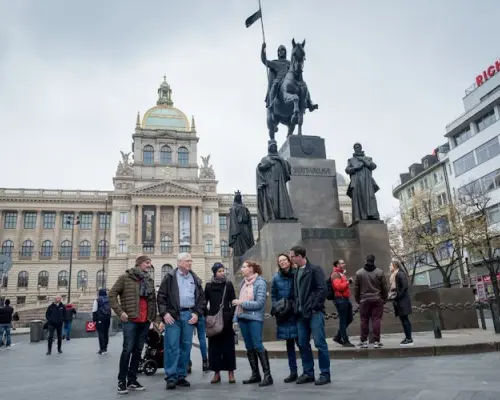


Prague 1000 years in the center of Europa historic tour
- Buy your Prague Walking Tour with a Historian with KKday with our price match guarantee and secure booking. Get informed, plan and book your amazing activities in Prague.
Package Options


Product Info
Purchase Notice
Duration: Lasts 3 hours
Reminders
Please refer to your voucher for final information regarding meeting points, pick-up locations, and pick-up time
Meeting point description: Meet at Café Cukrarna Mysak.(Vodičkova 710/31, 110 00 Nové Město, Czechia)
This tour requires a minimum of 2 and a maximum of 12 participants
FAQ
Prague Castle, a UNESCO World Heritage site, boasts over a thousand years of history, dating back to the 9th century. It began as a fortified settlement and grew to become the seat of Bohemian kings, Holy Roman Emperors, and later Czechoslovakian and Czech presidents. It houses St. Vitus Cathedral, Old Royal Palace, St. George's Basilica, and Golden Lane, reflecting various architectural styles from Romanesque to Gothic and Baroque, showcasing its continuous evolution and significance as a political and cultural center.
Prague earned its famous nickname, "The City of 100 Spires" (or sometimes "The City of a Thousand Spires"), due to its strikingly rich architectural landscape. The city skyline is adorned with numerous towers, church steeples, and ornate turrets, particularly prevalent in its historic Old Town and Lesser Town areas. These spires, built across centuries in Gothic, Baroque, and Renaissance styles, create a unique and picturesque panorama, making it a distinctive feature of Prague's beauty.
Prague acquired the moniker "Golden City" for several reasons. One theory links it to Emperor Charles IV, during whose reign in the 14th century, the city flourished and was adorned with gold-plated towers. Another association comes from Emperor Rudolf II in the late 16th century, who attracted alchemists to his court, hoping to discover the secret of making gold. The golden hue of Prague Castle at sunset also contributes to this romantic epithet.
Prague's architecture is a captivating timeline spanning over a millennium, showcasing a rich blend of styles. It began with Romanesque rotundas and basilicas, followed by the majestic Gothic cathedrals and bridges exemplified by St. Vitus Cathedral and Charles Bridge. The Renaissance brought elegant palaces, while the Baroque era transformed the city with grand churches, elaborate facades, and statues. Later periods added Neoclassical, Art Nouveau, and Cubist elements, creating a unique urban tapestry that tells the city's story through its buildings.
A historical tour of Prague Castle typically highlights several key sites. St. Vitus Cathedral is a Gothic masterpiece, significant for its stunning stained glass and royal tombs. The Old Royal Palace showcases historical halls like Vladislav Hall, used for coronations and jousting. St. George's Basilica, one of the oldest surviving churches, offers a glimpse into Romanesque architecture. Golden Lane, with its colorful miniature houses, provides insight into the lives of castle residents and artisans.
Prague's Old Town Square is an architectural marvel, displaying a blend of styles. The dominant Gothic influence is seen in the Týn Church with its imposing spires and the Old Town Hall with its astronomical clock tower. Renaissance elements are visible in some merchant houses around the square. Baroque palaces and churches, characterized by their elaborate decorations and grandeur, also flank the square. These diverse styles collectively tell the story of the city's rich past.
The spires that define Prague's skyline encompass a variety of architectural forms, contributing to its "City of 100 Spires" moniker. You'll find slender, pointed Gothic steeples, such as those on the Týn Church and St. Vitus Cathedral. There are also more ornate, onion-domed or helmet-shaped Baroque towers adorning numerous churches and palaces. Additionally, many historic buildings feature decorative turrets and pinnacles, all combining to create the city's distinct and abundant skyline.
Prague primarily gained the moniker "Golden City" during two significant historical periods. Firstly, under Emperor Charles IV in the 14th century, during the Bohemian Golden Age, when the city flourished culturally and politically, and many prominent buildings were adorned with golden decorations. Secondly, during the reign of Emperor Rudolf II in the late 16th century, who was deeply interested in alchemy and invited alchemists to Prague, hoping to transform base metals into gold, further cementing the "golden" association.
Get Help


